RACE AGAINST TIME: China Warns Overflowing Lake Could Unleash Fresh Disaster
Gallery
Videos
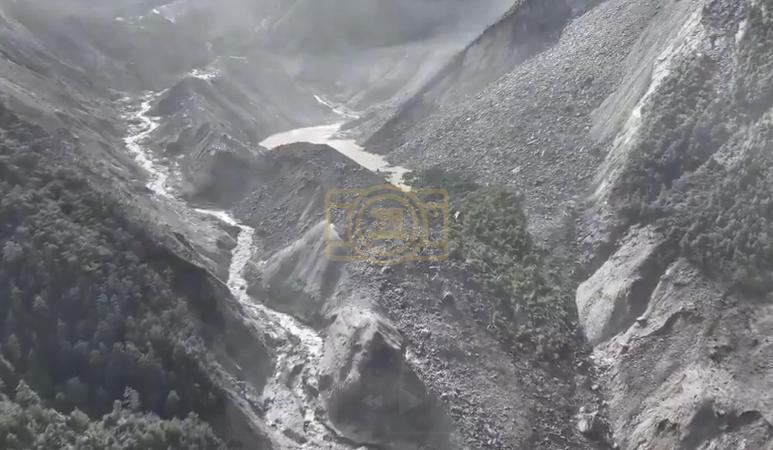
Just a day after flash floods killed hundreds of people along the Nepal-China border, Chinese authorities are now warning that a newly formed barrier lake is overflowing and could breach, potentially unleashing a second wave of flooding on communities already devastated by the first disaster. The lake formed near the confluence of the Chhochen Khola and Purepu Tsangpo rivers in Nepal, close to the Langtang Lirung peak where the original glacier collapse is believed to have originated. China's Ministry of Water Resources reported that the lake held approximately 2 million cubic metres of water as of Thursday morning, and officials expect another 3 million cubic metres to flow in over the following three days. That combination has prompted officials to label the situation a "high risk" of breach, a term reserved for scenarios where a sudden collapse could send another wall of water crashing downstream with little warning.
The barrier lake sits only a few kilometers upstream from Gyirong Port, the major land crossing between Nepal and China that was already devastated by Wednesday's flood, which authorities say traveled at speeds up to 200 kilometers per hour and generated a wall of water as high as 15 metres when it struck the checkpoint. Adding to the tension, a Chinese military drone captured footage on Friday morning of an avalanche depositing an estimated 50,000 cubic metres of ice debris directly into the barrier lake, further raising the water level and heightening concerns about an imminent breach. As the lake began overflowing non-stop, Chinese rescue teams were ordered to pull back roughly a kilometer from the site, and authorities in Nepal temporarily suspended their own rescue operations as a precaution. Witnesses described residents rushing uphill to safety as word of the overflow spread through nearby communities.
This type of hazard, known as a barrier or glacial lake outburst flood, occurs when landslide debris or ice dams up a river, creating a temporary lake that can collapse suddenly and catastrophically once pressure builds beyond what the natural dam can hold. Experts monitoring the situation say engineering teams have been deployed to track water levels and atmospheric conditions, while drones have delivered equipment to support ongoing assessments of the lake's stability. By Friday afternoon, state media reported that the immediate risk from the barrier lake had come under control, allowing rescue operations to resume, though officials continue to monitor conditions closely given the volume of water still expected to accumulate. Some scientists have noted that such lakes can occasionally drain out gradually rather than breaching all at once, though that outcome remains uncertain given the terrain and ongoing debris inflow.
The threat comes as the death toll from the original disaster continues to climb, with hundreds confirmed dead and well over a thousand people still missing across both the Nepali and Chinese sides of the border. The region remains far from stable, with several more days of rain in the forecast and unstable, collapsed earth continuing to form additional barrier lakes elsewhere in the watershed. Regional disaster experts have long warned that a lack of real-time, cross-border information sharing between Nepal, China, and India leaves downstream communities vulnerable to glacial lake hazards that can develop with little advance notice. As emergency teams work to secure the area, the overflowing lake serves as a stark reminder that the danger from this week's glacial collapse is far from over.