Tiny Flying Robots Gain Major Power Efficiency Breakthrough.
Gallery
Videos
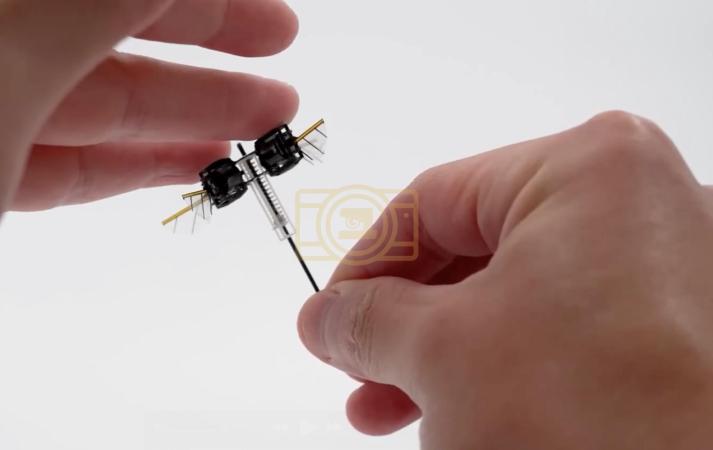
Researchers at the Massachusetts Institute of Technology have developed a major advancement in microrobotics by creating a new fabrication technique that produces low-voltage artificial muscles with significantly fewer defects. The innovation directly improves the performance and reliability of tiny flying robots designed to mimic the flight mechanics of insects.
These microrobots, which are roughly palm-sized and weigh less than 100 milligrams, rely on dielectric elastomer actuators to power their flapping wings. Traditional versions of these artificial muscles required high operating voltages and were prone to material defects that limited durability and control. The new method refines the manufacturing process, reducing imperfections in the elastomer layers and enabling consistent operation at much lower voltages.
With the improved actuators, the robots can achieve wing flapping frequencies of up to 100 hertz, allowing for greater lift, stability, and maneuverability. The higher efficiency also reduces energy demands, a critical factor for untethered flight and long-duration missions at such small scales. By enhancing both power density and reliability, the breakthrough brings microrobots closer to practical real-world deployment.
The potential applications for these bio-inspired systems are wide-ranging. Swarms of microrobots could assist with artificial pollination in agriculture, perform search-and-rescue operations in confined or hazardous environments, and carry miniature sensors for environmental monitoring. Their lightweight design and agile flight make them particularly suited for tasks that are difficult or dangerous for larger robotic platforms.
The development represents a convergence of materials science, soft robotics, and microfabrication, demonstrating how incremental improvements in actuator technology can unlock entirely new capabilities. As researchers continue to refine onboard power sources and autonomous control systems, insect-scale flying robots are moving from laboratory prototypes toward functional tools for industry, science, and public safety.