A "GIFT" FROM CARACAS: Trump Vows to Refill Empty Oil Reserve With Venezuelan Crude
Gallery
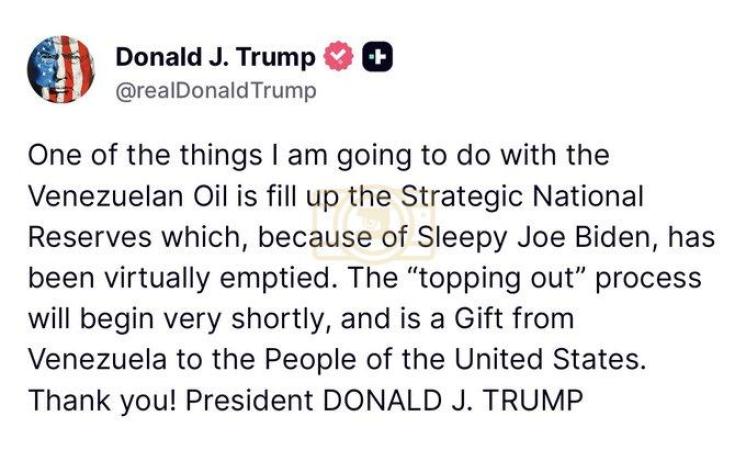
President Trump announced plans to use oil secured through a newly struck deal with Venezuela to begin refilling the U.S. Strategic Petroleum Reserve, which he says has been left dangerously depleted under the previous administration. In a social media post, Trump said the "topping out" process would begin very shortly, describing the incoming Venezuelan crude as a gift from Venezuela to the American people. The announcement builds on an agreement revealed Friday that grants the United States majority control over an estimated 65 billion barrels of Venezuelan oil reserves, a dramatic expansion of America's stake in a country long considered a rival on the world energy stage. As of late August, the Strategic Petroleum Reserve held roughly 290 million barrels, sitting at around 41 percent of its full 714 million barrel capacity and near a 44-year low.
The reserve's depleted state reflects years of drawdowns carried out under both the Biden and Trump administrations in response to a string of global energy disruptions, including Russia's invasion of Ukraine and, more recently, the ongoing conflict with Iran. While Trump placed the blame squarely on his predecessor, government data shows the emergency stockpile has continued shrinking during the current administration as well, reflecting the reserve's role as a tool for managing energy shocks regardless of who occupies the White House. It remains unclear exactly how quickly the new Venezuelan oil could begin flowing into the reserve, or whether American drivers would see any near-term relief at the pump as a result. Analysts note that meaningfully increasing Venezuelan oil output will require substantial new investment and infrastructure work before production can rise in any significant way.
This latest deal follows months of dramatic shifts in U.S.-Venezuela relations, beginning with the capture of former Venezuelan leader Nicolás Maduro by U.S. forces in early January and the installation of an interim government under Delcy Rodríguez. In the immediate aftermath, Trump had already announced that Venezuela would turn over between 30 and 50 million barrels of previously sanctioned oil to the United States, framing the earlier transaction as a way to benefit both nations financially. The new agreement goes considerably further, establishing majority American control over reserves that represent one of the largest untapped oil resources in the world, positioning U.S. companies to play a central role in rebuilding Venezuela's long-struggling energy sector. Major American oil firms, including Chevron and ExxonMobil, are expected to be central players in that redevelopment effort, though neither company has issued detailed public comment on this latest phase of the arrangement.
For now, Trump's announcement functions as much as a political statement as an energy policy update, tying the emotionally resonant imagery of restocking a depleted national reserve directly to his administration's broader Venezuela strategy. Whether the deal delivers the kind of rapid, tangible benefits Trump is promising will depend heavily on how quickly Venezuelan production can be scaled up and how efficiently that oil can be routed into America's reserve system. Given Venezuela's chronically underdeveloped oil infrastructure despite holding the world's largest proven reserves, experts caution that any significant increase in output is likely to unfold over months or years rather than days. Still, for an administration eager to showcase concrete results from its Venezuela policy, the promise of turning geopolitical maneuvering into a literal refill of America's emergency oil supply offers a powerful, easily understood narrative heading into the fall.