NO ROOM FOR ERROR: Helicopter Pilots Risk It All Beside Power Lines
Gallery
Videos
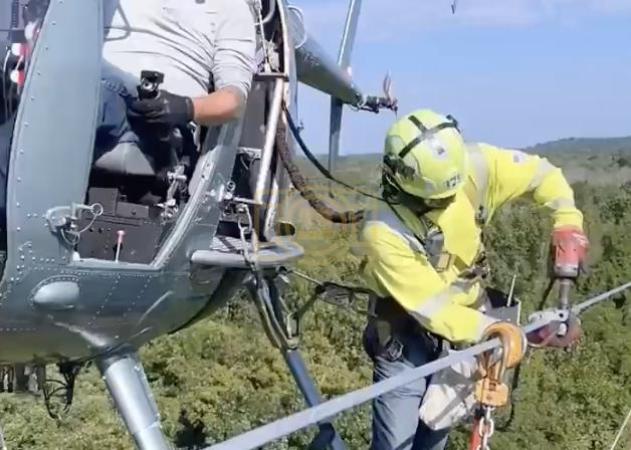
A video capturing a helicopter hovering just inches from high-voltage power lines has reignited fascination with one of the most nerve-wracking jobs in aviation: live-line utility work. In the footage, the aircraft, identified as N19FF, holds a near-motionless position over forested terrain while a lineman in full safety gear stands directly on the helicopter's structure, working on the transmission infrastructure beside him. It's the kind of scene that looks almost impossible until you understand the skill and precision required to pull it off. The pilot isn't just flying near power lines; he's holding a stationary hover close enough that his rotor blades can overlap the very wires he's trained his entire career to avoid.
The reason for flying this close comes down to cost and reliability. Utility companies generally prefer not to shut down major transmission lines for routine maintenance, since powering down a high-voltage line can cost tens of thousands of dollars per megawatt hour in replacement power, and outages ripple out to thousands of homes and businesses. Helicopter live-line work solves that problem by letting linemen perform repairs, hardware replacements, and inspections while the line stays fully energized, moving from span to span far faster than trucks or ground crews ever could. To make that possible, linemen typically bond themselves to the same electrical potential as the line itself, allowing them to work safely on live wires as long as they maintain proper distance from grounded structures like the towers.
None of this eliminates the danger, it just manages it. The job routinely appears on lists of the world's most hazardous aviation and utility roles, largely because of how many risk factors stack on top of each other at once: low-altitude precision flying, close proximity to fixed obstacles, sudden wind gusts, and the ever-present possibility of mechanical failure at the worst possible moment. Industry safety experts note that when procedures are followed correctly and crews are properly trained, the work is statistically no more dangerous than a lineman working from a bucket truck, but the margin for error while airborne is undeniably thinner. Even a brief engine failure during a hover this close to a live wire can turn a routine maintenance task into a life-threatening emergency within seconds.
What makes footage like this so gripping isn't just the visual of a helicopter parked in midair beside crackling high-voltage cables, it's the relationship it reveals between pilot and lineman. The lineman standing on that structure is trusting the pilot completely to hold a rock-steady position, often for extended stretches, without so much as a foot of drift in any direction. That level of trust, built through extensive training and repeated practice, is really what makes this kind of flying possible at all. It's a job most people will never do and few could imagine attempting, yet for the small number of pilots and linemen who specialize in it, it's simply another day keeping the lights on.