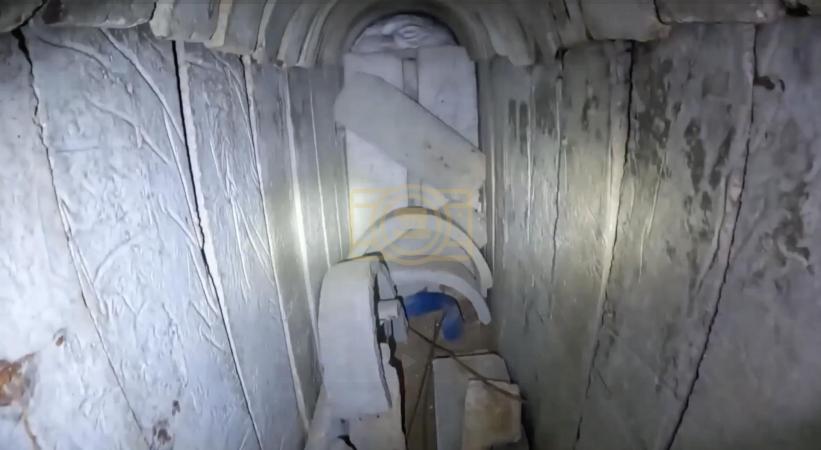
IDF Uncovers Kilometer-Long Hamas Tunnel in Gaza.

Gallery
Videos
Israeli forces have uncovered a one-kilometer-long tunnel complex in Beit Hanoun in northern Gaza, revealing what officials describe as a fortified underground network used by Hamas for operational planning, weapons storage, and personnel movement. Footage released on February 18, 2026, shows reinforced concrete corridors, vertical access shafts fitted with ladders, and multiple chamber-like spaces that Israeli authorities say functioned as hideouts and logistical nodes. Stacks of bagged materials believed to contain explosive compounds were also documented inside the structure.
According to Israeli military assessments, the scale and engineering of the tunnel reflect a long-term investment in subterranean infrastructure designed to offset Israel’s aerial and technological advantages. The use of concrete reinforcement, compartmentalized rooms, and concealed entry points indicates an intent to create survivable command environments and protected transit routes beneath densely populated areas. Such systems enable militants to move fighters, store weapons, and stage attacks while minimizing exposure to surveillance and airstrikes.
The discovery adds to longstanding concerns about the breadth of Hamas’s underground network. International estimates have previously suggested that the total length of tunnels in Gaza extends for hundreds of kilometers, constructed over many years using dual-use building materials that were originally intended for civilian development projects. Israeli officials argue that the diversion of these materials has significantly complicated reconstruction and demilitarization efforts by embedding military infrastructure within civilian zones.
From a tactical perspective, tunnels present a multidimensional challenge. They provide concealment, facilitate surprise operations, and create defensive depth, allowing militants to sustain combat capability even when surface structures are degraded. For Israeli forces, locating and neutralizing these networks requires a combination of intelligence gathering, engineering units, and specialized detection technologies. The process is resource-intensive and often slow due to the need to avoid secondary explosions and structural collapse.
The presence of explosives within the tunnel raises additional concerns about the potential for planned attacks or the use of the network as a storage and staging area for improvised munitions. Israeli authorities maintain that dismantling such infrastructure is a prerequisite for any long-term stabilization framework in Gaza, arguing that the persistence of underground military assets undermines both security arrangements and humanitarian recovery.
The broader strategic debate centers on how post-conflict governance and reconstruction can proceed in an environment where militant infrastructure is deeply embedded. The tunnel discovery underscores the complexity of demilitarization efforts and the technical challenges involved in verifying that underground capabilities have been fully dismantled. As operations continue, the focus remains on mapping the extent of the network, neutralizing remaining hazards, and preventing future reconstitution of subterranean militant systems.