ROBOT DOGS DEPLOYED: ICE Buys Boston Dynamics Bots for Immigration Operation

Gallery
Videos
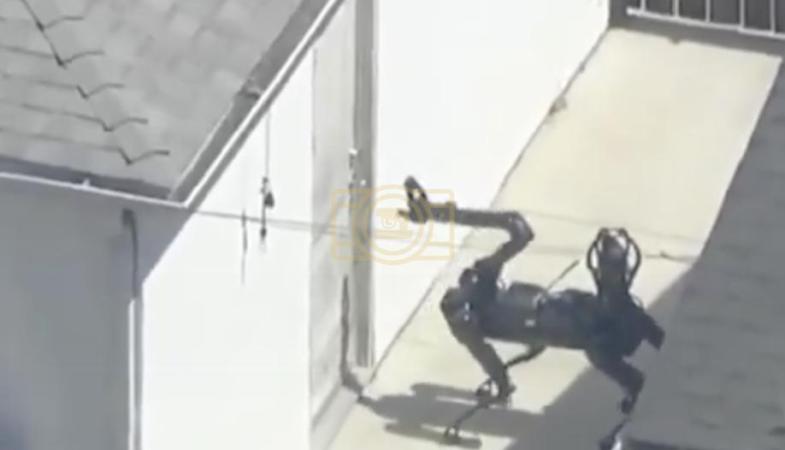
Immigration and Customs Enforcement is preparing to spend as much as $2 million on Boston Dynamics' four-legged Spot robots, according to a funding notice posted to the Department of Homeland Security's Acquisition Planning Forecast System. The document outlines plans to purchase the robots and related accessories, with the agency describing their purpose as providing a remotely operated capability for inspection, situational awareness, and hazard assessment in environments that could put personnel at risk. A senior DHS official confirmed the plans to reporters, clarifying explicitly that the robots will not be used to make arrests. With individual units starting around $75,000 before additional equipment, the budget suggests the contract could eventually field dozens of robots across ICE operations.
Spot is already a familiar presence in American law enforcement, with departments in cities including Los Angeles and New York having previously deployed the robot for tasks ranging from handling potentially dangerous objects to assisting during armed standoffs. The robots can be fitted with 360-degree live-feed cameras, robotic arms, and sensors capable of detecting vibration, gas, and radiation, giving officers a way to assess dangerous or confined spaces without physically entering them first. In one notable 2024 case, Massachusetts State Police used a Spot robot during a seven-hour standoff in Hyannis, crediting it with reducing risk to officers even after the suspect damaged the unit by gunfire. The U.S. Secret Service has also previously used similar robotic dogs to help secure Mar-a-Lago.
This latest purchase adds to a broader wave of technology acquisitions by ICE as the agency ramps up capacity amid the Trump administration's expanded immigration enforcement push. Just weeks earlier, ICE drew criticism for finalizing a separate contract worth up to $20 million for electric shock gloves intended to help officers control resisting individuals while reducing reliance on more severe use-of-force options. Boston Dynamics, for its part, has stated publicly that it will not authorize or partner with anyone seeking to use its robots as weapons or autonomous targeting systems, adding that it will act to address any misuse if it occurs. Whether that ethical stance translates into any operational restrictions specific to ICE's planned use remains unclear.
The announcement has already drawn pushback from some lawmakers, with a group of Democratic senators sending a letter to ICE's acting director urging the agency to cancel the robot dog contract entirely and redirect funding toward de-escalation training and stronger accountability measures instead. Critics have raised broader concerns about normalizing military-style robotics within civilian immigration enforcement, pointing to New York City's own police department abandoning a similar robot dog program in the past following public backlash. ICE and DHS, meanwhile, continue to frame the technology as a straightforward safety measure, arguing that sending a robot into an unstable or hazardous location is preferable to putting a human officer directly in harm's way. As the contract moves forward, the debate over where exactly the line falls between officer safety and expanding surveillance and enforcement capability seems likely to continue.