BIRD-BRAINED BREAKTHROUGH: Flapping Robot Swims, Then Soars
Gallery
Videos
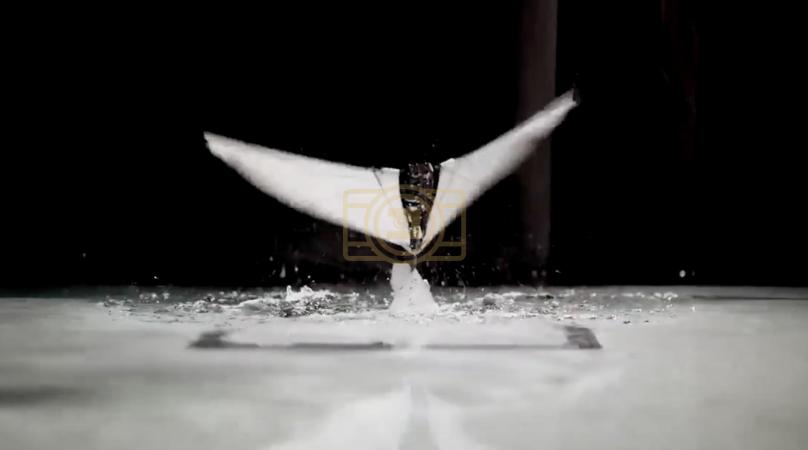
Engineers at MIT and EPFL have built a robot that solves a problem that has stumped roboticists for years: moving fluidly between water and air using the exact same set of wings. The machine weighs about 250 grams, roughly the weight of a can of soda, and takes its cues from puffins, loons, and other diving birds that dip underwater to hunt and then burst back into flight. What makes this so difficult is basic physics, since water is somewhere between 800 and 1,000 times denser than air, forcing most machines to be built for one medium or the other. This robot ignores that rule entirely, swimming and flying with a single pair of flexible wings and no propellers, paddles, or folding parts.
The performance numbers back up the ambition behind the design. Underwater, the robot swims at nearly 1 meter per second while flapping its wings about five times every second, a rhythm modeled directly on how real diving birds move through both mediums. Once it breaks the surface, it transitions into stable flight at around 6 meters per second, cruising through the air on the same wings that just propelled it through water moments before. Researchers found that wing stiffness had to hit a very particular sweet spot, flexible enough to bend efficiently underwater but firm enough to generate real lift once airborne. Testing showed the full transition from submerged to flying takes less than a second, a remarkably fast handoff between two completely different physical environments.
The hardest engineering puzzle wasn't swimming or flying individually, but the split-second moment of breaking through the surface. Engineers found that tilting the robot to roughly 70 degrees right before launch was the key, since this angle lifts the wingtips clear of the water and stops them from catching and dragging the robot back down. Get that angle wrong, and the robot either stalls at the surface or tips backward into the water instead of climbing into the sky. Notably, the robot pulls off this entire launch without any paddling feet, which is how many real diving birds like ducks and puffins typically help push themselves off the water. Instead, carefully tuned wing motion and body orientation alone are enough to do the job.
Beyond being a clever piece of engineering, the robot has a genuine research mission behind it. The vision is for oceanographers, marine biologists, and coastal researchers to be able to launch it from a boat or shoreline, fly it out to a hard-to-reach study site, then have it dive into the water to gather samples or take measurements. Once its underwater task is complete, it simply flaps back into the air and flies home with its data, all at a fraction of the cost of traditional research vessels or equipment. Testing has already moved beyond the lab, with the team running trials in both large water tanks and Switzerland's Lake Geneva to refine wing size, flap rate, and tail positioning. In essence, it's a tiny robotic puffin built not just to mimic nature, but to help scientists understand it better.