FLOAT, DANCE, REPEAT: UCLA's Playful Robots Redefine Robot Design
Gallery
Videos
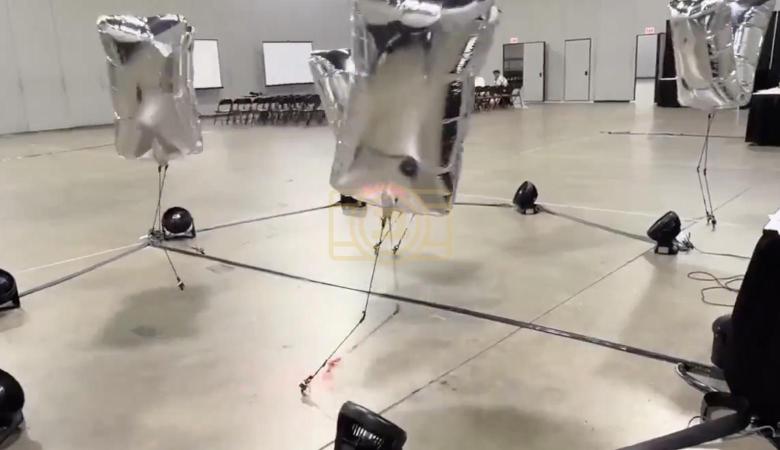
At a robotics conference typically dominated by sleek humanoids and industrial arms, one exhibit stood out for being almost impossibly whimsical: a small flock of robots made from helium balloons and spindly, articulated legs, floating and dancing their way across the exhibition hall. Called "Buoyant Choreographies," the installation was created by Dennis Hong and Yusuke Tanaka of UCLA's Robotics & Mechanisms Laboratory, known as RoMeLa, and debuted as an interactive art exhibit at the 2025 IEEE International Conference on Robotics and Automation in Atlanta. The robots themselves, built on a platform called BALLU, short for Buoyancy Assisted Lightweight Legged Unit, use a helium-filled balloon body to stay aloft while thin, motor-driven legs handle the actual walking, hopping, and turning.
What makes BALLU genuinely unusual in the world of robotics is a design philosophy built almost entirely around eliminating one of the field's most persistent challenges: robots falling over. Because the balloon body carries most of the unit's weight, the legs never need to support significant mass, meaning they can be built impossibly thin and lightweight, using just a single motorized joint per leg to achieve walking, backward stepping, sideways motion, turning, and even jumping. That buoyancy also makes the robot inherently stable in a way traditional legged robots simply aren't, since a BALLU unit is physically incapable of toppling over the way a heavier, motor-laden robot would. It's an elegant workaround to a problem that has consumed enormous amounts of engineering effort throughout robotics history, essentially removing the need for the complex stabilization systems most walking robots require.
The Atlanta exhibit pushed this playful platform even further by turning it into a genuinely interactive art piece rather than just a research demonstration. Visitors could engage with the floating robots through touch, handheld game controllers, or even by simply blowing air toward them, prompting the robots to respond in real time by shifting their movement patterns, changing the color of built-in RGB lighting on their legs, and displaying what the researchers describe as expressive, almost emotional reactions to human interaction. Multiple units moved simultaneously within a defined arena bordered by strategically placed fans, which created invisible boundaries to keep the robots contained without any physical walls or barriers. The unpredictability of each robot's buoyancy-assisted movement was embraced by the researchers as a core feature rather than a flaw, meaning no two interactions with the installation played out quite the same way.
The project builds on nearly a decade of research into buoyancy-assisted robotics at RoMeLa, with earlier BALLU prototypes dating back to 2016, when Hong's lab first introduced the concept as a novel way to rethink how legged robots could achieve stability and safety simultaneously. Beyond its debut in Atlanta, a version of the installation has also found a permanent home at the Seoul Robotics & Artificial Intelligence Museum, extending the project's reach as both a piece of interactive art and a public demonstration of unconventional robotics engineering. For Hong, who has built a career and a reputation, as the Washington Post once put it, as "the Leonardo da Vinci of robots," creating machines that blend genuine technical innovation with a sense of playfulness and human connection, "Buoyant Choreographies" represents a distinct departure from the high-powered humanoids that usually dominate robotics headlines, offering instead something gentler, safer, and arguably more fun to be around.