Loading
זעמל - Mayor Mamdani Announces 10,000 New ACS Vouchers for Low-Income Families   |  זעמל - Jerusalem - Marking the yahrzeit of the "Sanigoron Shel Yisroel..   |  זעמל - Slovakia: Hundreds of Yidden who traveled for the yahrtzeit of the holy Chasam Sofer zy"a participate in a grand Hachnasas Sefer Torah on the stree..   |  אידישער ווינקל - President Trump Approves Firing Squad Execution for Fort Hood Shooter Nidal Hasan   |  אידישער ווינקל - Gadi Eizenkot's Campaign Truck Drives Past PM Netanyahu's Residence Flashing Anti-Netanyahu Propaganda.   |  אידישער ווינקל - A Colorful Campaign: Mike Lawler Distributes Coloring Books to Children in His District   |  בקיצור - Motion Filed in Iranian Parliament to Impeach Foreign Minister Abbas Araghchi   |   זעמל - Mayor Mamdani Announces 10,000 New ACS Vouchers for Low-Income Families   |  זעמל - Jerusalem - Marking the yahrzeit of the "Sanigoron Shel Yisroel..   |  זעמל - Slovakia: Hundreds of Yidden who traveled for the yahrtzeit of the holy Chasam Sofer zy"a participate in a grand Hachnasas Sefer Torah on the stree..   |  אידישער ווינקל - President Trump Approves Firing Squad Execution for Fort Hood Shooter Nidal Hasan   |  אידישער ווינקל - Gadi Eizenkot's Campaign Truck Drives Past PM Netanyahu's Residence Flashing Anti-Netanyahu Propaganda.   |  אידישער ווינקל - A Colorful Campaign: Mike Lawler Distributes Coloring Books to Children in His District   |  בקיצור - Motion Filed in Iranian Parliament to Impeach Foreign Minister Abbas Araghchi   |  

Videos


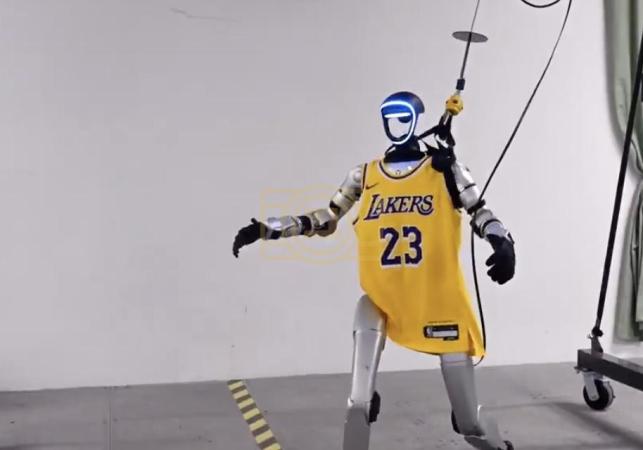
Researchers at Carnegie Mellon University and NVIDIA have developed a system that enables humanoid robots to move more like real athletes by bridging the gap between simulation and real-world physics. The framework, known as ASAP, allows robots to mimic complex human movements with unprecedented fluidity, as demonstrated in videos showing robots replicating the motions of elite athletes such as Cristiano Ronaldo, Kobe Bryant, and LeBron James.

ASAP addresses the common issue of physics mismatches between simulated environments and reality through a two-stage process. First, robots undergo imitation learning in simulation to capture natural athletic motion. Then, data fine-tuning aligns the learned behaviors with real-world physical constraints, resulting in movements that are smoother, more precise, and adaptable to unpredictable conditions.

The implications of this technology are significant. Beyond entertainment and research, humanoid robots with improved agility could assist in homes, performing tasks that require human-like coordination, or operate in high-risk environments where human presence is dangerous. The development marks a major step forward in robotics, demonstrating that combining advanced simulation techniques with real-world calibration can dramatically enhance robot performance and versatility.