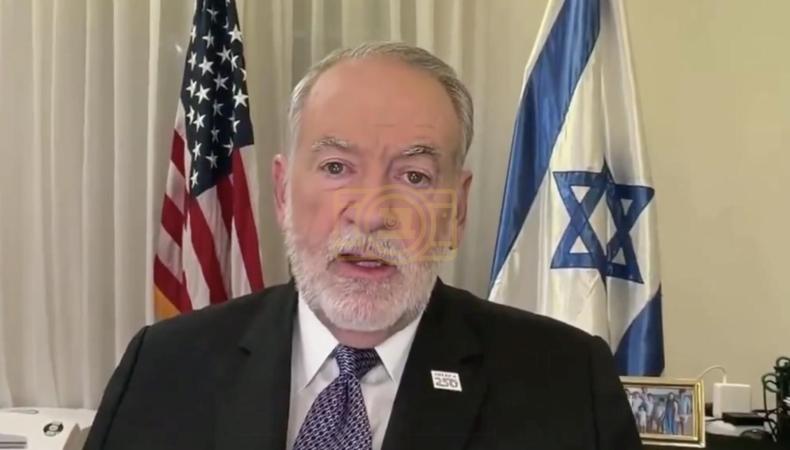
AMBASSADOR PUSHES BACK: Huckabee Blasts Genocide Accusations Over Gaza

Gallery
Videos
U.S. Ambassador to Israel Mike Huckabee delivered another characteristically blunt rejection of genocide allegations against Israel, using a striking visual argument to make his case. Pointing to images of Hamas leadership, Huckabee argued that the men shown don't look like people suffering from starvation. "If you look at Hamas leaders, you don't see people who are starving. You see people who need a good dose of Ozempic," he said, a comment that quickly drew attention for its blunt, almost dismissive framing of one of the most serious accusations leveled against any government. It's not the first time Huckabee has reached for this kind of language; he has previously made nearly identical remarks in other interviews, suggesting it's become a recurring talking point in his broader defense of Israeli policy in Gaza.
Beyond the rhetorical jab, Huckabee grounded his argument in claims about Israel's humanitarian conduct during the war. "Israel has been willing to feed the enemy and allow food, medicine, and supplies in, even at risk to themselves," he said, framing Israeli military operations as fundamentally defensive rather than exterminatory in intent. He has pointed to Gaza's continued population growth as further evidence against the genocide label, along with the argument that Israel possesses the military capability to destroy the territory far more swiftly and completely if annihilation, rather than self-defense, were truly the goal. Supporting these claims, Israeli coordination data from 2025 indicates that more than a million tons of food aid entered Gaza, delivered via hundreds of trucks daily throughout the conflict.
Huckabee's comments, however, have not gone unchallenged, and the criticism has been sharp. Detractors argue that population growth figures and aggregate aid tonnage don't, on their own, refute independent reporting on civilian deaths, displacement, and documented hunger inside Gaza. Critics have also noted that Gaza's population growth during the war has actually been lower than earlier projections would have suggested, a discrepancy attributed to both war casualties and a documented decline in births, complicating the simplicity of Huckabee's population-based argument. Public health commentators have separately taken issue with the Ozempic reference itself, arguing that invoking a weight-loss medication in the context of a humanitarian crisis trivializes reports of acute malnutrition that aid organizations and journalists on the ground have documented extensively.
The broader dispute reflects one of the most polarized fault lines in international discourse today, with supporters of Israel's position emphasizing Hamas's role in disrupting aid distribution and using civilian suffering for propaganda purposes, while critics point to independent humanitarian assessments describing persistent hunger, mass displacement, and civilian casualties as evidence that the crisis is real and severe regardless of aid volumes delivered. Both sides marshal statistics, whether population data, aid tonnage, or casualty figures, to support fundamentally different conclusions about what has actually unfolded in Gaza throughout the conflict. As with much of the debate surrounding this war, the numbers themselves are rarely disputed as strongly as their interpretation, leaving the underlying question of intent, and whether "genocide" is the accurate legal and moral term for what has occurred, as contested as ever.