DRONE THAT VANISHES: Northwestern Engineers Develop Drone That Nearly Disappears in Flight
Gallery
Videos
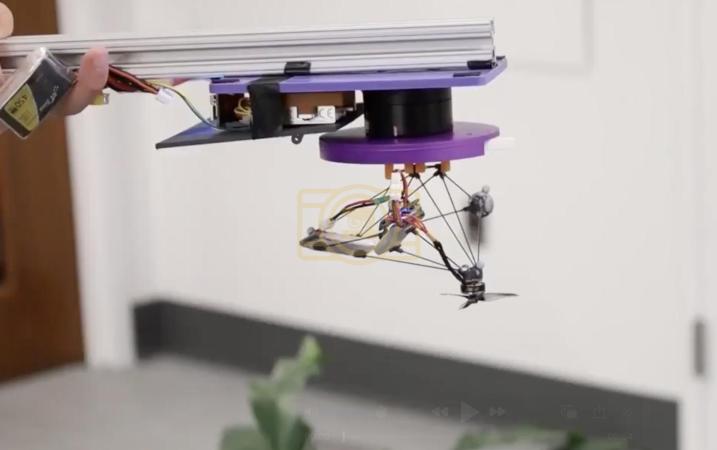
What if a drone could become almost invisible without using traditional camouflage? Researchers at Northwestern University have developed an experimental aircraft called Phantom Twist, which uses rapid rotation and motion blur to make itself far less noticeable to the human eye. Unlike conventional quadcopters, which have a stationary central body and multiple propellers, this unusual design uses a single motor and propeller while the entire drone spins in the opposite direction. Rotating at speeds of up to 25 times per second, its components blend together visually, creating the appearance of a faint, translucent haze rather than a recognizable flying machine. According to the researchers' visibility measurements, the prototype is approximately 10 times less visually perceptible than a comparable conventional quadcopter. The technology was presented at the Robotics: Science and Systems 2026 conference in Sydney, Australia, on July 16.
Developing Phantom Twist required more than simply making a drone spin faster. The research team used computational modeling and artificial intelligence to generate roughly 20,000 possible configurations, rearranging components such as the motor, propeller, batteries, circuit board and counterweight to reduce visibility while maintaining stable flight. The researchers then evaluated promising designs against real-world backgrounds using a computer model intended to approximate human visual perception, ultimately refining the configurations with the lowest visibility scores. The goal is not necessarily to create a military stealth aircraft, but to develop drones that can monitor wildlife, survey ecosystems and inspect infrastructure without attracting as much attention or disturbing their surroundings. However, Phantom Twist is not completely invisible, and its spinning propeller still produces noise while some wires and support rods remain visible. Northwestern's team says future versions could incorporate more transparent materials and quieter propulsion systems to make the aircraft even less noticeable.