MACHINES THAT MAKE MACHINES: NVIDIA Teaches Robots Precision Chip Work
Gallery
Videos
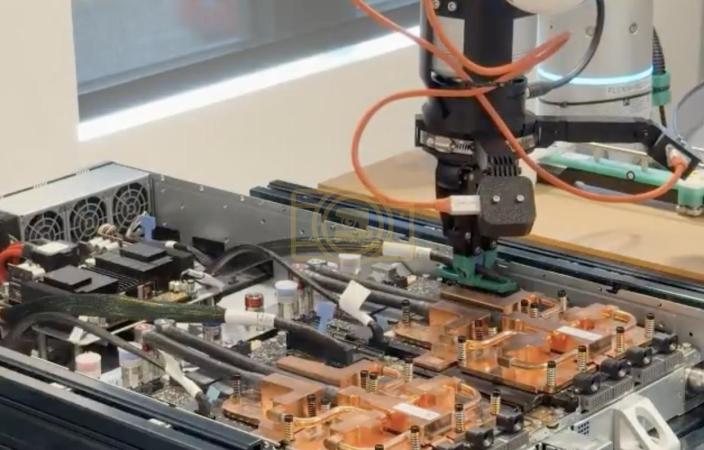
NVIDIA's Seattle Robotics Lab is tackling one of manufacturing's hardest open questions: can robots handle the kind of delicate, high-precision assembly work that AI hardware demands. Working alongside the company's Isaac engineering team and contract manufacturer Foxconn, the lab has been automating two notoriously difficult tasks in building GB300 tester trays, the fixtures used to verify GB300 compute modules before they ship. One task involves fastening a heavy electrical busbar into place with 16 screws, while the other requires lifting four cable-mounted connectors and threading them into tightly spaced sockets. Both jobs demand a level of dexterity and adaptability that has long kept this kind of work firmly in the hands of skilled human workers.
Rather than betting everything on end-to-end machine learning, the team built a hybrid system that leans on classical engineering where it works best and brings in AI only where it is truly needed. Busbar assembly relies on NVIDIA's FoundationPose perception model paired with a precision impedance controller, clearing a 95 percent success rate, while connector insertion required something more specialized: a custom pose-estimation framework called DOPER, purpose-built 3D-printed grippers, and a reinforcement-learning approach known as SPARR that blends simulation training with real-world force-feedback correction. The project is still experimental and has not yet reached NVIDIA and Foxconn's target of 99.5 percent reliability with cycle times under twice that of human workers, but NVIDIA says the results point toward flexible automation that could meaningfully ease the reliance on skilled labor as AI hardware production scales up.