CAUGHT ON CAMERA: Another Video Shoes Amazon Prime Air Jet's Fatal Overrun Sparks Safety Questions
Gallery
Videos
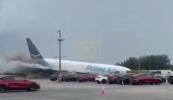
Newly circulated video captures the harrowing moment an Amazon Prime Air Boeing 767 freighter overran the runway at Miami International Airport on Sunday, September 6, 2026, ultimately crashing into a field near the airport's boundary and striking multiple vehicles. The aircraft, operated by cargo carrier 21 Air as Flight 7598, was arriving from Luis Muñoz Marín International Airport in San Juan, Puerto Rico, when it failed to stop on Runway 30 shortly before 2 p.m. Eastern time. Flight-tracking data reviewed by CNN indicated the plane was traveling at nearly 130 miles per hour, or roughly 113 knots, when it left the usable portion of the runway, and air traffic control audio reviewed by the network showed the pilots never declared an emergency before landing. The jet came to rest near a roadway beside two semi-trucks, largely intact but engulfed in flames, with a fuel leak reported at the scene.
The human toll was severe. Miami-Dade officials confirmed five people died and five others were injured, three of them critically, with victims trapped both in the cockpit and in vehicles struck by the aircraft on the ground. More than 60 fire units and roughly 200 personnel responded, using foam and specialized airport firefighting equipment to battle the flames while technical rescue teams worked to extricate people pinned inside crushed cars. Crews also searched for the plane's pilot and co-pilot, who were reported trapped in the cockpit before being removed and treated. Officials said it was still too early to determine whether all of the fatalities occurred aboard the aircraft or among those on the ground.
The observation about an Engineered Materials Arresting System, or EMAS, raises a legitimate point worth examining once investigators release more detail. EMAS beds are built from crushable, engineered materials placed at the end of runways specifically to safely stop aircraft that overrun the pavement, and they've prevented serious accidents at other airports in the past when planes departed the runway at speed. Whether Miami International's runway 30 safety area was equipped with such a system, and whether it would have made a meaningful difference given the reported speed and distance involved, are questions the National Transportation Safety Board will need to address as part of its formal investigation. The NTSB confirmed it has dispatched an investigative team to Miami, and Boeing said it is supporting that inquiry.
Runway excursions like this one remain the most common type of aviation incident worldwide, according to data from the International Air Transport Association, even though they rarely result in casualties on this scale. The aircraft involved was a 32-year-old Boeing 767-300 that originally flew as a passenger plane for several airlines before being converted into a cargo freighter in 2015. Boeing issued a statement extending condolences to the families of those who lost their lives and to everyone affected by the crash. As investigators work to determine why the aircraft was unable to stop, the tragedy has already reignited broader conversations about runway safety margins and arresting systems at major airports handling heavy cargo traffic.