MUSLIM NATO?: Turkey, Saudi Arabia, Pakistan Hold First Joint Security Summit
Gallery
Videos
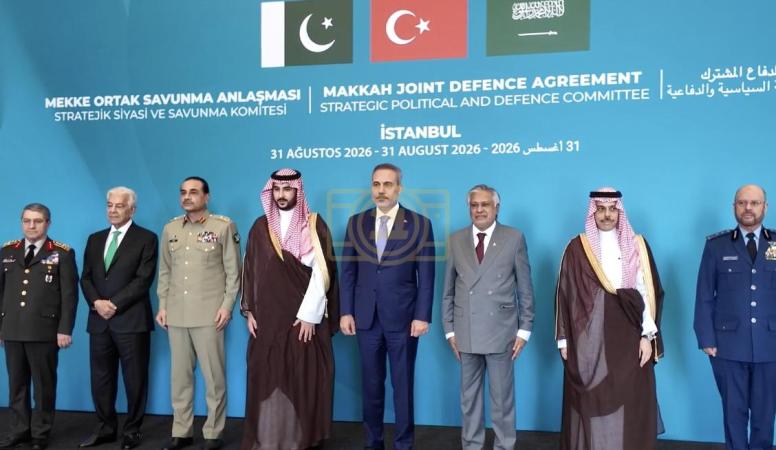
Top defense and foreign policy officials from Turkey, Saudi Arabia, and Pakistan gathered in Istanbul on Monday for the first formal meeting held under their newly signed Mecca Joint Defence Agreement. The session brought together foreign ministers, defense ministers, and military chiefs of staff from all three nations, marking the official launch of what has been described as a "political and defence strategic committee." According to Turkish Foreign Ministry sources, the agenda covered a wide range of international security issues alongside detailed discussions on deepening military cooperation and joint operational capabilities. Photos from the event showed the assembled officials posing in front of a multilingual banner bearing the agreement's name, with the flags of all three countries displayed prominently behind them.
The gathering follows the formal signing of the Mecca Joint Defence Agreement on August 7 in the Saudi holy city of Mecca, where Turkish President Recep Tayyip Erdoğan, Saudi Crown Prince Mohammed bin Salman, and Pakistani Prime Minister Shehbaz Sharif put pen to paper on a pact built around a single powerful clause. That clause states that any armed attack against one of the three nations will be treated as an attack against all of them, a structure modeled loosely on Article 5 of NATO's founding treaty. Notably, the text of the agreement does not name any specific adversary, with officials from all three governments repeatedly stressing that the pact is purely defensive in nature and open to any other nation wishing to join.
Analysts have been quick to note that despite comparisons to NATO, the Mecca pact functions quite differently in practice. Each of the three countries brings a distinct strength to the table, with Turkey contributing advanced defense-industrial capability, Saudi Arabia offering substantial financial resources, and Pakistan providing deep military experience along with the distinction of being the only nuclear-armed nation in the Muslim world. Combined, the three countries field nearly 1.4 million active military personnel, along with roughly 3,400 aircraft, 6,000 tanks, and more than 340 naval assets, according to the 2026 Global Firepower Index. Despite that considerable joint strength, experts caution that Pakistan's nuclear deterrent is unlikely to formally extend to cover Saudi Arabia or Turkey under the current terms of the agreement.
The timing of the pact's formation is closely tied to the region's shifting security landscape, arriving amid renewed fears of a broader confrontation involving Iran and continued instability stemming from Houthi attacks originating in Yemen. For Gulf nations like Saudi Arabia, the agreement offers a hedge against the perceived limits of American security guarantees in the region, while for Turkey, it extends an already growing web of defense partnerships that includes Qatar, Syria, and Libya. Whether this new committee structure evolves into something resembling a true collective defense institution or remains a looser framework for coordination, Monday's meeting in Istanbul represents the first concrete step toward putting the historic agreement into practice.