OpenAI Unveils Human-Like Learning Robots.
Gallery
Videos
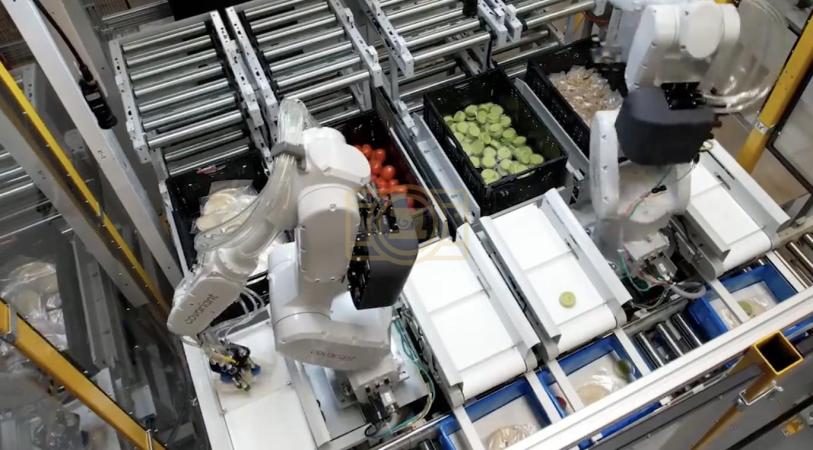
A major advance in industrial automation is emerging as Covariant, an OpenAI spinoff, introduces its Robotics Foundation Model, RFM-1, designed to enable robots to learn and reason in ways that more closely resemble human cognition. Unlike traditional robotic systems that rely on rigid, preprogrammed instructions, RFM-1 integrates knowledge from large-scale online datasets with real-world visual observation, allowing machines to predict outcomes, adapt to new scenarios, and refine their actions dynamically.
At the core of the system is a predictive reasoning framework. Before executing a task, the robot generates internal visual simulations of possible outcomes, effectively “imagining” how an action will unfold. By comparing these simulations against real-time sensory input, the system can identify obstacles, adjust its approach, and select the most efficient path to completion. This anticipatory capability represents a shift from reactive automation to forward-planning behavior, a key milestone in robotics research.
RFM-1 also introduces natural language interaction as a control layer. Operators can issue simple text prompts describing objectives rather than programming detailed motion sequences. The model interprets these instructions, maps them to physical actions, and continuously updates its plan as environmental conditions change. In dynamic settings such as warehouses—where item placement, lighting, and workflow vary constantly—this flexibility significantly improves performance and reduces the need for manual reconfiguration.
The training methodology combines internet-scale visual and textual data with observation of physical tasks, enabling the model to generalize across different objects and workflows. This approach allows a single robotic system to handle a wide variety of picking, sorting, and packing operations without extensive retraining, lowering deployment costs and accelerating scalability for logistics providers.
Industry analysts view foundation models for robotics as a pivotal development comparable to the introduction of large language models in software. By unifying perception, reasoning, and action within a single architecture, systems like RFM-1 move automation beyond narrow, task-specific programming toward broadly capable physical intelligence.
While the immediate applications are concentrated in supply chain and fulfillment environments, the underlying technology has implications for manufacturing, retail, and service robotics. As predictive simulation, language control, and real-time learning converge, robots are poised to operate with greater autonomy in complex, unstructured settings.
The introduction of RFM-1 signals a transition from static automation to adaptive machine behavior, where robots can evaluate context, anticipate challenges, and modify their actions without explicit human intervention. For industries facing labor shortages and increasing demand for efficiency, this capability represents a significant step toward more resilient and intelligent operational systems.