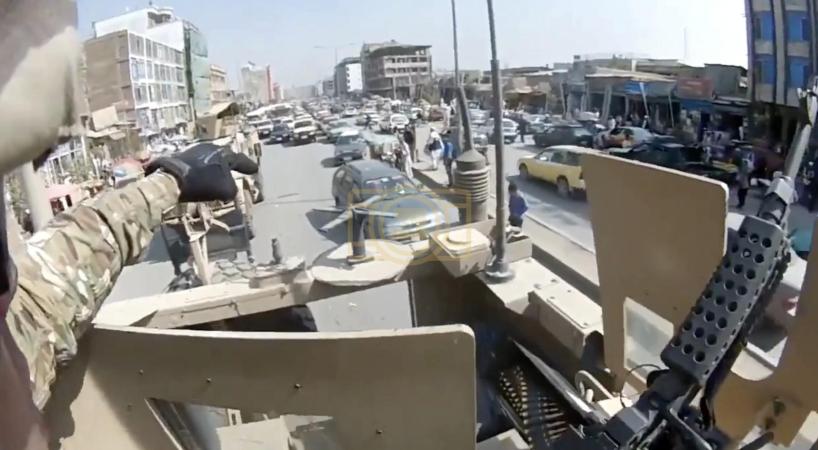
ROAD WARNING: U.S. Soldier Confronts Iraqi Car at Close Range.
Gallery
Videos
A tense moment inside a U.S. military convoy in Iraq shows how quickly an apparently ordinary traffic situation could become a serious security concern. In the footage, an MRAP gunner reacts to an Iraqi civilian vehicle following the American vehicle at extremely close range, first throwing a water bottle toward the car before drawing an M9 pistol as a warning. The dramatic encounter highlights the heightened suspicion surrounding approaching vehicles during the Iraq War, when troops faced the possibility that a civilian vehicle could conceal an improvised explosive device.
The gunner's reaction can be understood in the context of U.S. convoy procedures designed to keep potentially hostile vehicles at a safe distance. Army guidance from the Iraq campaign specifically warned that vehicles approaching from behind could pose a VBIED threat and instructed convoy personnel to signal approaching drivers to stop before taking further measures if they continued closing the distance. Military guidance also identified aggressive or erratic driving as a possible warning sign, although such behavior alone was not considered sufficient evidence to justify lethal force.
Escalation-of-force procedures were intended to provide soldiers with a sequence of responses between doing nothing and immediately using deadly force. Historical U.S. military reporting from Iraq describes measures that could include visual and verbal warnings, displaying weapons, warning shots and, when circumstances warranted, progressively stronger action against a vehicle or its occupants. The danger was that soldiers had only seconds to determine whether an approaching driver was simply careless, unaware of convoy restrictions or potentially attempting an attack.
That environment made close approaches particularly unsettling for convoy gunners, who could not reliably determine a driver's intentions from inside an armored vehicle. U.S. Army publications from the period noted that civilian driving behavior could create serious security problems because gunners had difficulty distinguishing aggressive driving from hostile intent, while VBIED attacks had specifically targeted military convoys. The threat was real, but so was the possibility of innocent civilians becoming caught in a dangerous misunderstanding, a problem documented in several Iraq-era escalation-of-force incidents.
The footage therefore offers a striking glimpse into the split-second decisions faced by American troops operating on Iraqi roads. While the exact circumstances surrounding this particular recording cannot be independently established from the footage alone, the response shown is consistent with the broader security environment and escalation-of-force concerns documented during the war. What appears at first to be a bizarre confrontation over a civilian driver following too closely ultimately illustrates why convoy discipline, distance and rapid threat assessment became matters of life and death for troops on Iraq's roads.