Scientists Unveil Clothing That Dresses You in 10 Seconds Using Air-Powered "Vines"
Gallery
Videos
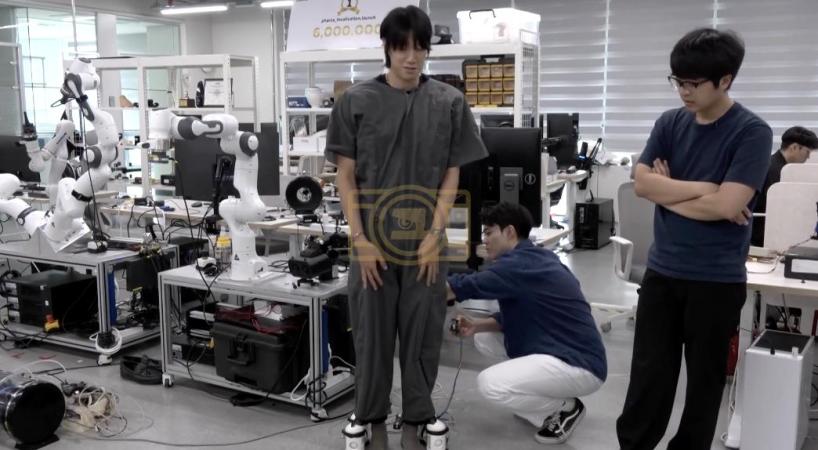
Researchers at South Korea's KAIST and Stanford University have unveiled a strikingly simple yet ambitious piece of robotics: clothing that puts itself on. The system relies on soft, air-pressurized "vine" robots sewn directly into the fabric, which inflate and glide the garment up and around the wearer's body in roughly 10 seconds, turning the clothing inside out as they advance. Modeled after the way ivy climbs a wall by growing at its tip rather than moving its entire structure, the vines allow the fabric to wrap stably around curved and uneven surfaces without needing complex programming or a wearer who stands perfectly still.
The idea traces back to an unexpectedly ordinary moment: KAIST postdoctoral researcher and lead author Kim Nam Gyun said the concept came to him while getting caught in the rain during a bike ride, wishing a raincoat could simply put itself on as he pedaled. That instinct evolved into a soft robotic system capable of navigating narrow gaps and adapting to slippery, sticky, or sloped surfaces, according to KAIST professor Ryu Jee-Hwan, who worked alongside Stanford's Allison Okamura and her research group on the project. Unlike earlier dressing-assistance robots that typically require a person to remain motionless during the process, this system functions even as the wearer moves, a distinction the team says makes it far more practical for real-world use.
Beyond convenience, the researchers see significant potential for the technology in settings where speed and hands-free operation genuinely matter, including assisting elderly or disabled individuals with daily dressing, rapidly suiting up workers in semiconductor cleanrooms, and equipping firefighters and other emergency responders with protective gear in a fraction of the usual time. The work, titled "Self-Wearing Adaptive Garments via Soft Robotic Unfurling," was published in the peer-reviewed journal IEEE Robotics and Automation Letters and was recognized as one of just five standout papers selected from more than 1,700 submissions to the journal in 2025. The team frames the achievement as a reminder that, even amid the current wave of AI-driven innovation, breakthroughs in mechanical engineering remain just as essential to building robots that work in the real world.