South Korea Successfully Launches New Rocket That Deploys 13 Satellites.
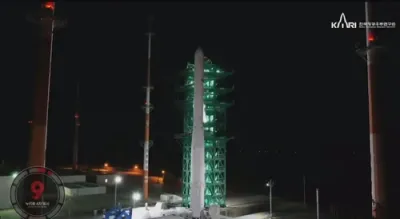
South Korea achieved a major milestone in its space program as its homegrown Nuri rocket successfully launched early Thursday from the Naro Space Center, deploying 13 satellites into orbit. This marks the fourth successful mission for the Nuri rocket and the first led by the private company Hanwha Aerospace, using technology developed by the Korea Aerospace Research Institute.
The 516-kilogram CAS500-3 Earth-observation satellite was the mission’s primary payload, accompanied by 12 CubeSats. Positioned in a 600-kilometer orbit, the CAS500-3 satellite will monitor auroras, airglow, and Earth’s magnetic fields. Initial contact was confirmed via Antarctica’s King Sejong Station, signaling the mission’s technical success.
Science Minister Kyunghoon Bae hailed the launch as clear proof of South Korea’s advanced space capabilities and emphasized the country’s ongoing plans for additional missions. The involvement of the private sector reflects a growing trend toward commercial space operations, positioning South Korea as a competitive player in the global aerospace industry.
By combining domestic technology with private sector innovation, South Korea is demonstrating both technical prowess and strategic foresight. The successful Nuri launch not only strengthens the nation’s scientific and commercial ambitions but also signals an expanding role for South Korea in international space exploration and satellite deployment.