HATE CRISIS: Rahm Emanuel Warns Antisemitism Is Raging Across America
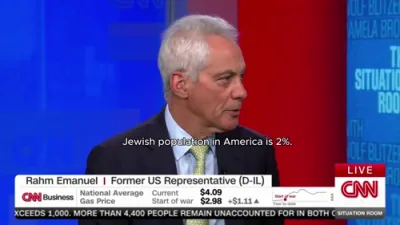
Former US Representative Rahm Emanuel issued a stark warning about the state of antisemitism in the United States, calling it a sickness that is currently raging across the country. He stressed that the problem is not confined to one political party and should not be treated as a Democratic or Republican issue. Instead, Emanuel described antisemitism as an American crisis that demands attention from the entire nation. He pointed to the disproportionate targeting of Jewish Americans as clear evidence of the threat. The remarks frame hatred against Jews as a symptom of deeper national struggles rather than a narrow partisan dispute.
Emanuel cited a striking statistic to underscore the scale of the problem. Jews make up only two percent of the US population, yet they were the target of roughly 70 percent of all religiously motivated hate crimes last year. He used this figure to argue that the community faces an outsized burden of hostility. In his view, a country that seeks out scapegoats has already begun to lose confidence in itself. The former lawmaker presented the data as a wake-up call that should transcend everyday political divisions.
He went further by separating personal faith from the broader societal challenge. Emanuel stated that his own faith is not the problem facing the country. What truly concerns him is the fact that Americans appear to be losing faith in America itself. By drawing this distinction, he sought to shift the focus away from any single religious group and toward the health of the national spirit. The comments position antisemitism as both a moral failing and a warning sign of eroding collective belief.
The former representative urged society to confront the hatred directly rather than allow it to fester along partisan lines. He argued that treating the issue as a shared American responsibility is essential if the country is to move past scapegoating. Emanuel’s language suggested that continued attacks on Jews reflect a deeper uncertainty about the nation’s direction and values. Addressing the problem, in his assessment, requires acknowledging its national character instead of assigning blame to one side of the political spectrum.
His message carried a clear call for unity in the face of rising hate. By highlighting the extreme concentration of religiously motivated crimes against a small minority, Emanuel aimed to illustrate how far the problem has spread. He linked the search for scapegoats to a loss of national self-belief, presenting the two as closely connected. The remarks leave little doubt that he sees antisemitism as a test of whether America still trusts in its own foundations. For Emanuel, confronting this sickness is necessary not only for Jewish Americans but for the country as a whole.