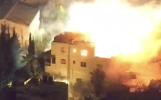

Israeli security forces carried out an overnight demolition of the family home of Walid Sabarneh in the Judea and Samaria town of Beit Ummar, following his role in last year’s deadly car-ramming and stabbing attack at the Gush Etzion Junction. The assault claimed the life of 71-year-old Aharon Cohen and wounded three others, including an Israeli soldier, before both attackers were neutralized at the scene by responding forces.
The operation was conducted under darkness with engineering units and armored support securing the area while bulldozers leveled the two-story structure. Illumination flares lit the site as troops ensured there were no disturbances during the controlled demolition. Israeli authorities described the action as part of a longstanding counterterrorism measure intended to deter future attacks by imposing direct consequences on perpetrators and their support networks.
Home demolitions have been used for decades as a punitive and preventative tool within Israel’s broader security framework. Officials argue that the policy creates a tangible disincentive for would-be attackers by signaling that acts of terrorism will carry personal and familial costs beyond the immediate operational outcome. Supporters within Israel’s security establishment maintain that, when applied selectively and following legal review, the measure contributes to reducing the frequency of certain types of attacks in high-risk areas.
Research frequently cited in policy discussions has suggested that such demolitions can produce short-term declines in specific forms of terrorism in affected localities. Proponents view this as evidence that deterrence mechanisms—combined with intelligence operations, rapid response protocols, and defensive infrastructure—form a layered strategy aimed at protecting civilians. Critics, however, question the long-term effectiveness and humanitarian implications of the practice, arguing that it may generate additional grievances. Israeli officials counter that the primary responsibility of the state is the protection of its citizens and that deterrence remains a critical component of that mission.
The Gush Etzion Junction attack occurred during a period of heightened tensions marked by a series of vehicular and knife assaults targeting Israeli civilians and soldiers. Such attacks are often difficult to predict and require immediate on-scene neutralization, placing significant emphasis on preventative measures designed to disrupt future plots. The demolition of Sabarneh’s residence reflects the continuation of that doctrine, signaling that individuals who carry out lethal attacks—and the environments that enable them—will face decisive consequences.
For many Israelis, the memory of Aharon Cohen’s killing underscores the human cost of these incidents and reinforces public support for robust counterterrorism policies. Government officials have reiterated that the objective is not punitive for its own sake but to prevent further loss of life by reinforcing deterrence and maintaining operational pressure on militant networks.
As security forces remain on alert across Judea and Samaria, the overnight demolition serves as both a response to a past attack and a warning aimed at preventing future violence. Within Israel’s strategic calculus, the message is clear: acts of terrorism will be met with swift, concrete action designed to safeguard civilians and uphold national security.
גאלערי
ווידעאס