טראמפ רעדט וועגן די שלום וואס וואשינגטאן די סי ברענגט
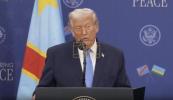
President Donald J. Trump formally outlined the conditions of the newly signed Washington Accords, a historic peace agreement between the Democratic Republic of Congo and Rwanda aimed at ending one of the deadliest conflicts of the last half-century. Speaking at the Donald J. Trump Institute of Peace in Washington, D.C., the President emphasized that the accords were built on four non-negotiable pillars: a permanent ceasefire, the disarmament of all non-state armed groups, the safe return of refugees, and full accountability for atrocities committed throughout the decades-long war.
“These terms are clear,” Trump declared. “A permanent ceasefire, the disarmament of non-state forces, provisions for refugees to return to their homes, and justice and accountability for those who have committed illegal atrocities.”
The agreement, signed December 4, 2025, by DRC President Félix Tshisekedi and Rwandan President Paul Kagame, represents what the Trump Administration calls the strongest U.S.-brokered peace deal in Central Africa's modern history. The conflict, centered in mineral-rich eastern Congo, has killed more than six million people since 1996—one of the largest death tolls since World War II. Prior ceasefire attempts collapsed due to rebel activity, foreign interference, and fierce battles over control of cobalt and coltan reserves vital to global technology supply chains.
Under the Washington Accords, Rwanda has formally committed to halting all support for the M23 rebel group, whose offensives repeatedly destabilized the region. In return, the Democratic Republic of Congo agreed to dismantle radical Hutu militias operating near the Rwandan border. Trump highlighted that these steps were essential to breaking the cycle of proxy warfare that fueled mass displacement, massacres, and humanitarian crises.
A crucial element of the accords is the repatriation of millions of refugees and internally displaced families. For years, civilians fled their homes as rebel factions and militias clashed over territory. The new framework guarantees international oversight, humanitarian access, and secure corridors to facilitate their safe return.
Equally important is the justice and accountability component. Trump stressed that war crimes, ethnic massacres, and crimes against humanity would not be ignored. The agreement establishes mechanisms for investigations, tribunals, and cooperation with international partners to ensure perpetrators—regardless of affiliation—are held responsible.
The accords also include economic integration provisions designed to turn eastern Congo’s vast mineral wealth into a stabilizing force rather than a driver of violence. By promoting transparent extraction partnerships and regionally coordinated development, the deal aims to counter the long-standing influence of armed groups and reduce Rwanda’s alleged backing of militias, widely documented in past UN reports.
Supporters argue that the Washington Accords signal a major diplomatic victory for the Trump Administration, comparable in ambition to the Abraham Accords in the Middle East. By combining peace enforcement, economic development, and justice mechanisms, the United States is positioning itself as the primary architect of stability in a region long neglected by the international community.
Although challenges remain and full implementation will require sustained pressure, the Washington Accords mark the most comprehensive and enforceable framework ever crafted to end the Congo–Rwanda conflict. For now, the Trump Administration is celebrating what it views as a monumental win for peace, security, and American leadership on the world stage.
גאלערי
ווידעאס
