שיפל אויף א אייזיגע טייך אין אוהייאו
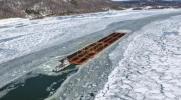
A powerful towboat pushing multiple barges struggled to break through thick ice on the Ohio River near Warsaw, Kentucky, as a rare February 2026 cold snap brought commercial navigation to a near standstill. The river, a critical artery for American industry and agriculture, has not experienced a full freeze since 1977, making the current conditions highly unusual and operationally disruptive.
The towboat’s slow progress through dense ice sheets illustrates the severity of the recent temperature plunge, which followed a week of sustained subfreezing weather across the region. While the river has not completely frozen over, heavy ice flows have formed along key stretches, forcing vessels to reduce speed, delay transits, or halt movement entirely. The U.S. Coast Guard has responded by establishing safety zones from February 4 through March 1, 2026, restricting navigation to prevent hull damage, barge breakaways, and potential collisions caused by shifting ice.
Historical records confirm that the last time the Ohio River fully froze was in January 1977, when temperatures in Cincinnati dropped to an extreme -25°F. During that period, the ice became thick enough for people to walk across sections of the river, an event that caused widespread shipping disruptions and economic delays. The current cold snap has not reached those record lows, but the persistence of ice flows has echoed many of the logistical challenges seen nearly five decades ago.
The situation underscores the vulnerability of inland waterways to sudden polar vortex events, even in an era of generally warmer winters. Prolonged cold spells can still generate significant ice accumulation, particularly when river currents slow and nighttime temperatures remain well below freezing. For operators, these conditions demand constant monitoring, reinforced hull integrity, and coordination with Coast Guard directives to maintain safety.
Despite the operational setbacks, the river remains open in limited capacity, with icebreakers and towboats carefully navigating narrow channels of moving water. The slow-moving flotillas serve as a visible reminder of how extreme weather can impact supply chains, energy transport, and regional commerce. As temperatures gradually moderate, traffic is expected to resume normal patterns, but the February freeze of 2026 will likely be remembered as one of the most significant ice events on the Ohio River since the historic winter of 1977.
גאלערי
ווידעאס
