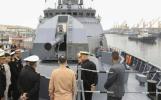

Russia’s defense ministry released footage showing the Steregushchiy-class corvette Stoikiy arriving at Iran’s southern port of Bandar Abbas, marking the start of a new phase of joint naval activity between Moscow and Tehran. The docking ceremony featured Russian and Iranian flags, formal greetings, and coordinated port protocols, underscoring the increasingly visible military cooperation between the two countries.
The visit precedes scheduled joint drills with Iran’s Islamic Revolutionary Guard Corps in the Gulf of Oman, an area of strategic importance due to its proximity to the Strait of Hormuz, one of the world’s most critical maritime energy corridors. A significant share of global oil shipments passes through this narrow waterway, making any coordinated military presence in the region a matter of international security interest. The exercises are expected to focus on maritime security operations, coordinated maneuvering, and tactical interoperability between Russian naval units and IRGC naval forces.
This development reflects a broader pattern of deepening defense ties between Moscow and Tehran since the outbreak of the Ukraine war in 2022. Military collaboration has expanded across multiple domains, including drone technology, training exchanges, and multilateral exercises such as the Maritime Security Belt series. The arrival of a modern corvette equipped for anti-surface and anti-submarine warfare highlights Russia’s intent to project a capable naval presence beyond its traditional operating theaters.
The timing of the drills is particularly notable given the current U.S. force posture in the region, which includes carrier strike groups and additional air assets positioned to deter Iranian aggression and protect key shipping lanes. The proximity of Russian and Iranian naval operations to these deployments introduces a complex operational environment in which multiple great-power and regional actors are conducting simultaneous military activities within a confined maritime space.
Security analysts view the exercises as both symbolic and practical. Symbolically, they demonstrate a shared willingness by Russia and Iran to challenge Western influence and coordinate in strategically sensitive waterways. Practically, they provide both militaries with opportunities to refine joint command structures, communications protocols, and tactical procedures that could be relevant in future contingencies.
The potential involvement of additional partners, including China, would further amplify the geopolitical message, signaling an emerging alignment among states seeking to counterbalance U.S. and allied naval dominance. Even without direct participation, the optics of coordinated drills near a global energy chokepoint reinforce the perception of a shifting security landscape in the Middle East and adjacent maritime regions.
For regional stakeholders and global markets alike, the exercises serve as a reminder of the strategic competition unfolding around critical sea lanes. While the stated objectives center on maritime security and anti-piracy cooperation, the broader context—heightened tensions, overlapping deployments, and competing power projections—ensures that these maneuvers will be closely monitored by defense planners and policymakers worldwide.
גאלערי
ווידעאס