צוויי אמעריקאנע נעיווי שיפן האבן געמאכט א קרעש
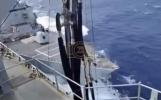
A U.S. Navy underway replenishment operation in the Caribbean Sea on February 11, 2026, resulted in a minor collision between the guided-missile destroyer USS Truxtun and the fleet replenishment oiler USNS Supply, leaving two sailors with minor injuries and prompting a formal investigation into ship-handling procedures.
The incident occurred while USNS Supply was conducting a dual replenishment, simultaneously refueling USS Gettysburg on one side as USS Truxtun maneuvered into position on the opposite beam. During the approach, Truxtun made contact with Supply, scraping along the support vessel’s hull. Initial assessments indicate that both ships sustained only superficial damage and remained operational following the mishap.
Underway replenishment is one of the most technically demanding maneuvers in naval operations, requiring precise speed matching, station-keeping, and continuous communication between bridge teams. Even small deviations in relative motion can result in hull contact, particularly when multiple ships are operating in close proximity. Standard protocols call for conservative approach speeds, clear helm commands, and strict adherence to separation distances to mitigate risk.
Preliminary analysis, including a frame-by-frame review conducted by maritime historian Sal Mercogliano, suggests that Truxtun’s bridge team may have misjudged closure rate and lateral spacing during final approach, leading to a violation of established collision-avoidance procedures despite favorable weather and sea conditions. Such errors typically trigger comprehensive reviews of navigation practices, watchstanding performance, and command oversight.
The Navy has emphasized that safety remains its top priority and that all incidents of this nature are subject to detailed investigation to determine contributing factors and implement corrective measures. These reviews often result in updated training protocols, procedural refinements, and, when necessary, accountability actions within the chain of command.
While the physical impact was limited, the event highlights the inherent complexity of replenishment-at-sea operations, which are essential to sustaining forward naval presence and global mission readiness. The ability to transfer fuel and supplies without entering port allows carrier strike groups and surface action groups to maintain operational tempo across extended deployments.
Both vessels continued normal operations following the collision, and the injured sailors were treated for minor conditions. The Navy’s investigative findings will likely inform future seamanship training and reinforce the importance of precision ship handling during close-quarters maneuvering.
Incidents of this type, though rare, serve as reminders that even routine logistics evolutions demand the highest levels of situational awareness and procedural discipline to ensure the safety of personnel and the integrity of the fleet.
גאלערי
ווידעאס
