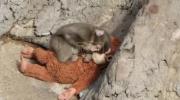

A young orphaned Japanese macaque named Punch has captured global attention after video footage showed him clinging tightly to a stuffed toy that served as a surrogate mother during the earliest and most vulnerable stage of his life. Born in July 2025 at Ichikawa Zoo, Punch was rejected at birth and initially struggled to survive in an enclosure housing more than fifty macaques, where his small size and lack of maternal protection left him exposed to bullying and social exclusion.
Zoo caretakers intervened with a carefully managed rehabilitation plan, providing Punch with a plush orangutan toy to replicate the tactile comfort typically supplied by a mother. The soft surrogate offered psychological stability during a period when the infant macaque weighed only 500 grams and displayed clear signs of stress and withdrawal. Video recordings from that time show Punch rarely separating from the toy, dragging it with him across the concrete floor and clutching it while resting, a behavior consistent with attachment responses observed in primate orphan care.
Over the following months, staff implemented gradual reintroduction protocols designed to build Punch’s confidence and social competence. These steps included controlled visual exposure to other macaques, monitored proximity sessions, and the strategic placement of tolerant adult animals nearby. The approach aimed to prevent further aggression while allowing Punch to observe normal troop interactions and begin mimicking social behaviors.
Recent footage documents a significant behavioral shift. Punch has been seen climbing onto the backs of other macaques, initiating contact rather than avoiding it. Most notably, an older monkey has begun to embrace him, an important affiliative gesture within macaque social structures that signals acceptance and reduces the risk of future aggression. This transition marks a critical milestone, as successful integration into the troop is essential for long-term psychological health and species-typical development.
Punch’s physical condition has improved alongside his social progress. His weight has increased to approximately two kilograms, reflecting better feeding patterns and reduced stress. Caretakers attribute this growth to both nutritional support and the stabilizing effect of social contact, which plays a central role in primate well-being.
The contrast between Punch’s early isolation and his current interactions highlights the effectiveness of patient, behaviorally informed rehabilitation strategies in captive primate management. While the surrogate toy remains a symbol of his early coping mechanism, his decreasing reliance on it and increasing engagement with other macaques indicate that he is transitioning from artificial attachment to genuine social bonds.
Punch’s journey illustrates the resilience of young primates when provided with appropriate environmental support and carefully structured social opportunities. What began as a story of abandonment has evolved into one of recovery, adaptation, and acceptance within a complex social group, offering a rare and hopeful look at the processes that underpin emotional and behavioral development in macaques.
גאלערי
ווידעאס