איראן'ס פארטריבענער קרוין פרינץ פאהלאווי שטעלט זיך אלס קנעכט און נישט אלס פירער.
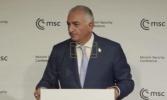
Exiled Iranian Crown Prince Reza Pahlavi told supporters at the Munich Security Conference that he is not seeking political office, personal power, or any formal title, declaring that the Iranian people “deserve better than the crap that is ruling us right now.” His remarks reinforce a long-standing message that his role is not to replace one authoritarian system with another, but to help facilitate a transition toward a secular and democratic framework determined by the will of the Iranian population.
Pahlavi, the son of Iran’s last shah and a prominent opposition figure since the 1979 revolution, has increasingly framed himself as a unifying national figure rather than a claimant to the throne or executive authority. By explicitly rejecting personal ambition, he seeks to address concerns among Iranians—both inside the country and in the diaspora—who remain wary of centralized power after decades of political repression under the current regime.
The speech emphasized principles of accountability, popular sovereignty, and institutional reform, presenting a vision in which any future government would be established through a democratic process rather than hereditary succession or revolutionary imposition. Pahlavi’s approach reflects an effort to broaden his appeal beyond monarchist circles and position himself as a transitional facilitator capable of coordinating opposition groups with differing political orientations.
His criticism of the Islamic Republic was framed not only in political terms but also as a failure to uphold Iran’s historical and cultural legacy. By contrasting the country’s past achievements with its current governance, he sought to connect national identity with the demand for systemic change. This narrative resonates with segments of the opposition that view the present leadership as both politically illegitimate and economically mismanaged.
The timing of the remarks at an international security forum underscores the growing visibility of Iranian opposition figures on the global stage. As geopolitical tensions involving Iran continue to intersect with broader regional and international dynamics, external platforms provide opportunities for opposition leaders to articulate alternative visions for the country’s future and to seek diplomatic recognition of their constituencies.
Pahlavi’s insistence that he does not seek formal authority is intended to build credibility among supporters who prioritize democratic legitimacy over personality-driven politics. Whether this positioning will translate into a cohesive opposition movement remains uncertain, but the message signals a strategic attempt to align leadership rhetoric with the principles of pluralism, institutional governance, and self-determination that many Iranians have demanded throughout successive waves of protest.
גאלערי
ווידעאס
