די דריי פרעזידענטן ביים אונטערשרייבן די שלום אפמאך
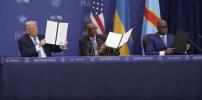
President Donald J. Trump hosted one of the most consequential diplomatic ceremonies of his presidency on December 4, 2025, as he joined Rwandan President Paul Kagame and Democratic Republic of Congo President Félix Tshisekedi in signing the historic Washington Accords. The event, held at the White House and followed by a formal program at the Donald J. Trump Institute of Peace, marked the culmination of an intensive U.S.-brokered effort to end the prolonged conflict destabilizing eastern Congo.
The Washington Accords lay out a comprehensive framework designed to dismantle the armed networks that have fueled decades of violence. Central to the agreement is a mandate for the Democratic Republic of Congo to intensify crackdowns on anti-Rwanda militias, including the FDLR, which has operated for years along the border. In parallel, Rwanda has agreed to halt all covert or alleged support for the M23 rebel group, whose resurgence repeatedly plunged the region into crisis.
Beyond security measures, the accord integrates a robust economic partnership aimed at transforming eastern Congo’s mineral wealth from a source of conflict into a foundation for stability. The agreement promotes joint development and transparent cooperation on cobalt, coltan, and other strategic minerals—resources essential to U.S. battery production, semiconductor manufacturing, and defense technology. By linking peace to economic progress, the Trump Administration has positioned the United States as a central partner in Africa’s mineral future.
This strategic approach represents a major departure from previous international efforts, including the 2024 Angolan mediation, which failed to secure meaningful commitments from either side. Trump’s direct engagement, backed by American leverage and diplomatic pressure, created the conditions necessary for both Kagame and Tshisekedi to agree to enforceable terms and long-term monitoring mechanisms.
Officials from both nations praised U.S. leadership, noting that no prior initiative brought together political, security, and economic solutions under a single, enforceable framework. With built-in accountability provisions, disarmament timelines, and international oversight, the Washington Accords are widely seen as the most comprehensive peace agreement ever attempted in the region.
For supporters of the Trump Administration, the moment symbolized the return of decisive American leadership on the global stage—one that pairs strength with pragmatic diplomacy, and peace with economic opportunity. The signing of the Washington Accords is already being compared to the Abraham Accords for its ambitious scope and for Trump’s ability to bridge historic divides between once-hostile leaders.
While the implementation ahead will be complex, the signing ceremony marked a turning point. By bringing Kagame and Tshisekedi together under U.S. mediation, President Trump delivered a breakthrough many considered impossible. The Washington Accords now stand as a testament to the power of American-led diplomacy to reshape regions, strengthen global supply chains, and open a new path toward lasting peace in Central Africa.
גאלערי
ווידעאס
