די שנעלקייט פון אמעריקאנע און איזראעלי לופט מאכט
גאלערי
ווידעאס
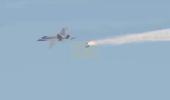
A dramatic video circulating across social media has captured global attention, showing a fighter jet maneuvering through the sky as missiles streak past in what appears to be an active combat environment linked to the ongoing Israel-Iran confrontation. Posted early Sunday by a user identified as Mwai, the footage quickly amassed millions of views, fueling a wave of online reactions that range from awe at the pilot’s apparent skill to broader discussions about Western air superiority and the evolving nature of modern aerial warfare.
The clip shows what defense analysts believe to be a fourth-generation multirole fighter, likely an F-16 platform, executing high-speed evasive maneuvers while multiple missile contrails cut across the frame. The aircraft appears to deploy countermeasures and alter its flight vector rapidly, a combination of tactics designed to defeat radar-guided and heat-seeking threats. Such maneuvers require precise timing, situational awareness, and confidence in both the aircraft’s performance envelope and the pilot’s training, particularly in contested airspace where reaction windows are measured in seconds.
Supporters of the U.S. and Israel have pointed to the footage as a vivid demonstration of pilot proficiency and advanced training standards. Many described the survival of the aircraft as a testament to the layered defensive systems integrated into Western fighter doctrine, including electronic warfare suites, missile warning receivers, and countermeasure dispensers. These capabilities, combined with rigorous pilot preparation, are intended to maintain air dominance even when facing dense surface-to-air or air-to-air missile environments.
The video’s caption, emphasizing American strength and technological capability, contributed to its rapid spread and patriotic framing. For audiences aligned with U.S. and Israeli security perspectives, the imagery reinforced the perception of qualitative military superiority and the effectiveness of joint operational standards. The visual of a jet outmaneuvering incoming threats resonates strongly in the context of recent regional escalations, where control of the air domain remains a decisive factor in both deterrence and active operations.
At the same time, the footage has generated debate among analysts and observers regarding its precise origin, the identity of the aircraft, and the tactical circumstances under which it was recorded. Combat videos released or amplified during periods of heightened conflict often serve both informational and psychological functions, shaping public perception while signaling capability to adversaries. Regardless of its source, the clip underscores the central role of airpower in the current confrontation and highlights the risks faced by pilots operating in missile-saturated environments.
From a strategic standpoint, the incident reflects the broader dynamic of the Israel-Iran shadow conflict, where air operations, missile exchanges, and proxy engagements intersect across multiple theaters. The ability of U.S. and Israeli aircraft to operate effectively under threat conditions reinforces deterrence by demonstrating survivability and mission continuity. For military planners, such engagements also provide real-world validation of tactics, technologies, and training methodologies developed to counter increasingly sophisticated air defense systems.
The viral spread of the video illustrates how modern conflicts are not only fought in physical domains but also in the information space, where imagery of battlefield performance can influence public morale, alliance confidence, and adversary calculations. In this case, the visual narrative of a jet evading multiple missiles has become a symbol for supporters of Western military capability, while also prompting scrutiny and analysis from defense observers worldwide.
As tensions between Israel and Iran continue to evolve, moments like this—whether captured by official channels or civilian observers—serve as reminders of the high stakes and technical complexity of contemporary air combat. The combination of advanced aircraft, skilled pilots, and integrated defensive systems remains a defining element of U.S. and allied military effectiveness in contested regions.
