פאלשע עי איי ווידיאו פון א אוקריינא אטאקע אויף פוטין'ס הויז
גאלערי
ווידעאס
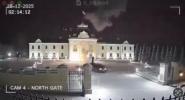
Footage circulating online that allegedly shows a Ukrainian drone attack on President Vladimir Putin’s residence in Russia’s Novgorod region has been exposed as entirely fabricated. Despite widespread sharing and alarming claims, the video does not depict a real-world event and is instead an AI-generated creation designed to mislead viewers.
The viral clip claims to show drones striking the Valdai residence, accompanied by explosions and vehicles moving through the scene. However, several glaring inconsistencies immediately raise red flags. Most notably, cars are seen driving calmly through water fountains and blast zones without reacting to explosions — behavior that defies basic physics and real-world conditions. The movement of vehicles appears unnatural and digitally manipulated, a common hallmark of synthetic video.
Additional scrutiny reveals a suspicious timestamp reading December 28, 2025, at 2:14:23, further aligning with the timing of Russia’s December 28–29 claims that Ukrainian drones attempted to target the area. Kyiv has denied these allegations, and U.S. intelligence assessments indicate there is no evidence that President Putin himself was ever the intended target.
While Russian authorities released separate, unverified drone footage to support their narrative, the viral video spreading online is not among them. Independent fact-checkers have confirmed the circulating clip is artificial, created using generative AI tools capable of simulating explosions, vehicles, and aerial attacks with increasing realism.
This incident underscores a growing problem in modern information warfare. Artificial intelligence is now being weaponized to amplify misinformation, exploit geopolitical tensions, and manipulate public perception. In high-stakes conflicts like the Russia-Ukraine war, deepfake videos can spread faster than verified facts, shaping narratives before truth has a chance to catch up.
As AI-generated content becomes more convincing, viewers are urged to remain cautious, question sensational claims, and rely on verified sources. In this case, the evidence is clear: the video alleging a Ukrainian drone attack on President Putin’s residence is not real, and its purpose is deception, not documentation.
