די אמעריקאנע מיליטער האט פריש אטאקירט איראן דעם שבת
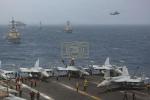
US Launches Third Wave of Airstrikes on Iran Following Strike on Commercial Vessel and Strait of Hormuz Closure
WASHINGTON — The United States military launched a massive wave of precision airstrikes against military targets inside Iran late Saturday night, marking the third major round of strikes this week. The direct military action follows an attack by Iran’s Islamic Revolutionary Guard Corps (IRGC) on a commercial cargo ship in the highly strategic Strait of Hormuz and Tehran’s subsequent declaration that the vital waterway is closed.
According to U.S. Central Command (CENTCOM), American forces utilized land- and sea-based fighter aircraft, unmanned drones, and naval ships to strike approximately 140 Iranian military targets. The operation focused heavily on degrading the regime's capability to threaten international shipping lanes.
Targets hit in the widespread bombardment included drone and missile sites, naval capabilities, ammunition storage facilities, communication networks, and coastal surveillance positions along Iran’s shoreline.
"During three nights of strikes this week, CENTCOM has struck more than 300 targets at the direction of the Commander in Chief to degrade Iran's ability to attack civilian mariners and commercial vessels freely transiting the strait," CENTCOM said in a public statement.
Escalation in the Strait of Hormuz
The latest flashpoint was triggered when the IRGC fired upon the *M/V GFS Galaxy*, a Cyprus-flagged container ship transiting the global shipping bottleneck.
CENTCOM officials confirmed that the vessel sustained severe engine room damage and an onboard fire, leaving one civilian crew member missing. The United Kingdom Maritime Trade Operations (UKMTO) agency verified that the vessel sustained damage to its rear, forcing emergency responses off the coast of Oman.
The IRGC defended the action via state media, claiming it fired a "warning shot" at a ship navigating an "unauthorized route" that had allegedly switched off its tracking systems. Following the incident, Tehran declared that the Strait of Hormuz—through which roughly 20% of the world's petroleum passes—would be closed "until further notice and until the end of US interference in the region".
Ceasefire Collapses Amid Regional Fallout
The rapid escalation effectively shatters a fragile Memorandum of Understanding (MOU) originally intended to pause the broader conflict that erupted earlier this year. The strikes hit just hours after critical diplomatic talks in Muscat, Oman—aimed at preserving safe maritime passage—dissolved without a resolution.
President Donald Trump ordered the heavy retaliatory strikes, having previously noted that while the U.S. had agreed to continue talks with Tehran, “the Cease Fire is OVER!”
In the wake of the latest American strikes, the conflict has rapidly widened across the Middle East. The IRGC claimed retaliatory ballistic missile strikes against what it labeled "US-linked targets" across five regional countries, including the Al Udeid Air Base in Qatar, logistics support centers at Oman's Port of Duqm, and facilities in Jordan, Bahrain, and Kuwait. Neighboring Gulf states have been pulled into the crossfire, with air defense systems throughout the region maintaining the highest level of readiness to intercept incoming projectiles.
The escalating conflict and the effective blockade of the Strait of Hormuz have already sent shockwaves through global energy markets, stoking fears of a sharp spike in global oil prices and further economic instability ahead of the November U.S. congressional elections.
גאלערי
