א הייוועי אין אפריקע אנגעפולט מיט היישעריקן
גאלערי
ווידעאס
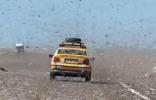
Drivers crossing desert routes near Boujdour encountered extraordinary conditions as massive swarms of locusts blanketed roadways, forcing vehicles to push through dense clouds of insects that struck windshields and accumulated across the asphalt. Video from the scene shows reduced visibility, with the insects forming thick layers that made traction uncertain and created hazardous driving conditions.
The swarms appear to be part of a broader regional surge in locust activity linked to favorable breeding conditions following periods of moisture in otherwise arid zones. When vegetation temporarily increases in desert environments, locust populations can multiply rapidly, forming large migratory groups capable of traveling long distances and overwhelming landscapes in a matter of hours.
Motorists reported the insects colliding continuously with vehicles, creating both visual obstruction and potential mechanical issues, particularly for cooling systems and air intakes. The buildup on road surfaces also posed a skid risk similar to driving over organic debris, requiring reduced speeds and heightened caution.
Beyond the immediate transportation hazards, large locust swarms carry significant agricultural implications. While the affected area near Boujdour is sparsely cultivated, migrating swarms can threaten croplands if they move toward more fertile regions. Monitoring and early warning systems are critical in tracking swarm movement and coordinating control measures before major crop damage occurs.
Authorities in affected areas typically deploy ground and aerial response teams when swarms approach populated or agricultural zones, using targeted treatments to limit further spread. In remote desert corridors, however, mitigation efforts are often limited, leaving travelers to contend with the insects until the swarms pass.
The footage underscores the scale and density that locust formations can reach, transforming open desert highways into moving biological obstacles. For drivers, the event served as a reminder of the unpredictable environmental conditions that can arise in arid regions, where sudden ecological shifts can have immediate impacts on travel safety and regional food security.
As monitoring continues, officials will assess whether the swarms remain confined to sparsely populated areas or begin migrating toward farming districts, a development that would elevate the situation from a transportation disruption to a broader economic and food supply concern.
