$300 BUYS 660 MILLION: Iran's Money Collapses Under Economic Siege
Gallery
Videos
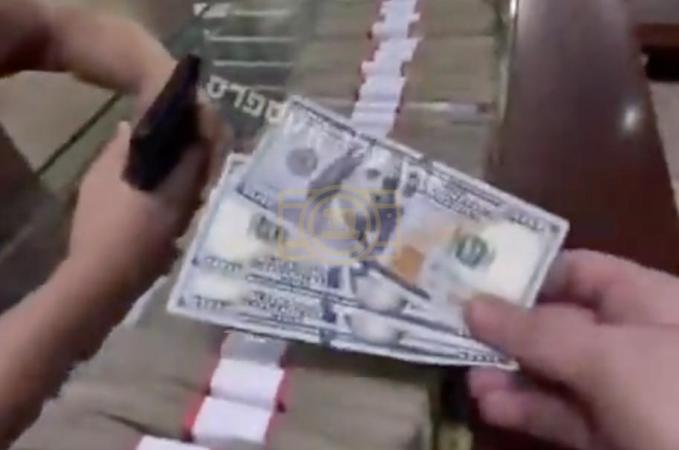
A video circulating online shows something that says more about Iran's economy than any government statement could: stacks upon stacks of rial banknotes piled next to a handful of hundred-dollar bills, illustrating just how far the currency has fallen. At the current street rate, $300 now equals roughly 660 million rials, a jarring visual of what economic collapse actually looks like in everyday transactions. That exchange rate isn't an exaggeration. The rial hit a record low of more than 2.2 million to the dollar on the free market in early September 2026, according to websites that track Iran's informal currency trading, a rate far removed from the government's official exchange figure of around 1.37 million rials per dollar.
The gap between those two numbers, official and street, tells its own story about how disconnected government messaging has become from daily economic reality. Iran operates a dual exchange rate system, and while the central bank continues to reference the official rate in government statistics and wage benchmarks, ordinary Iranians buying imported goods, gold, or foreign currency are paying prices set by the real, much weaker street rate. The rial has now lost roughly 60 percent of its value since the Iranian calendar year began in March, when the dollar traded at approximately 1.35 million rials. That kind of currency collapse compounds daily, and each fresh record low represents another blow to Iranian households trying to hold onto savings.
The reasons behind the crash are not particularly mysterious. Iran's currency has been in freefall since U.S. and Israeli strikes launched an ongoing conflict in late February, and the decline has accelerated sharply since Washington reimposed a naval blockade on Iranian ports in July, following the collapse of a short-lived ceasefire. That blockade has choked off Iran's oil export revenues, one of its few remaining sources of foreign currency, while the U.S. Treasury has also cut off Iran's access to regional banks, severing critical channels for clearing import payments. On top of military and financial pressure, inflation has climbed to catastrophic levels, with year-on-year price growth reaching approximately 84 percent as of August, driven by staggering increases in staples like vegetable oil and eggs.
For ordinary Iranians, none of this is abstract. Wages, even when they technically rise, cannot keep pace with inflation running well above 80 percent, meaning real purchasing power keeps shrinking month after month. Many who can afford to have turned to gold and foreign currency simply to preserve whatever value their savings still hold, a telling sign of how little confidence remains in the rial itself. Iran's Central Bank Governor has pushed back against claims that the country faces a foreign-exchange shortage or economic collapse, saying the bank stands ready to inject up to $2 billion into the market to stabilize the currency. Whether that intervention can meaningfully slow a slide driven by war, sanctions, and a naval blockade remains to be seen, but for now, the numbers on exchange counters across Tehran keep telling a different story than the one coming from officials.