VERTICAL RISE: New Turkey Drone Tests Deck Landings and ISR Flights at Sea.
Gallery
Videos
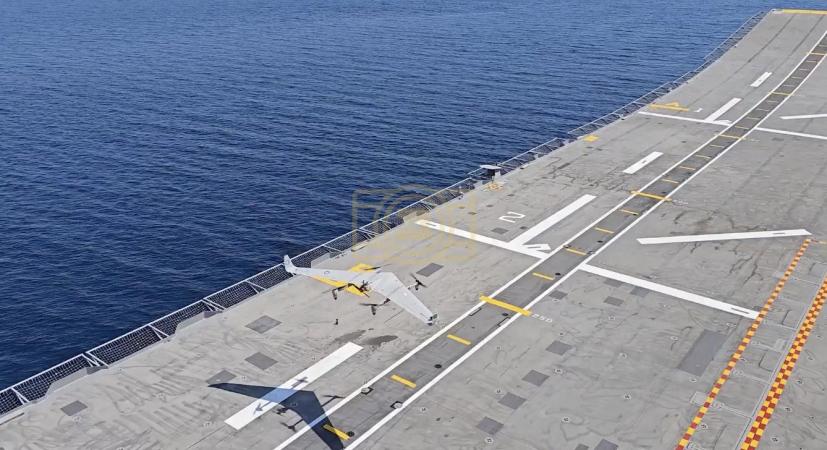
Baykar’s vertical takeoff and landing UAV known as KALKAN has begun flight testing aboard the Turkish Navy’s flagship TCG Anadolu. The Ministry of National Defense confirmed that the compact drone has already completed successful operations from the ship’s deck. Additional trials have also taken place from the corvette TCG Burgazada, demonstrating early flexibility across different vessel types. The tests mark a practical step toward integrating small, runway-independent drones into routine naval operations. Officials described the initial flights as smooth and consistent with design expectations.
KALKAN weighs only 78 kilograms and relies on electric lift propellers for vertical takeoff and landing. Once airborne, the aircraft transitions into forward flight to perform intelligence, surveillance, and reconnaissance missions over open water. Video from the trials shows the drone lifting cleanly from the deck, clearing the ship’s superstructure, and heading out to sea before returning for a controlled vertical landing. The compact size allows it to operate from limited deck space that larger unmanned systems cannot use. This capability expands the number of Turkish Navy ships that can deploy organic aerial surveillance.
The drone offers approximately six hours of endurance, providing a useful window for persistent monitoring without the logistical burden of larger platforms. Its low operating cost makes it an attractive complement to the heavier Bayraktar systems already in service. By adding a lightweight VTOL option, the navy gains the ability to maintain continuous situational awareness even when flight decks are occupied by other aircraft or helicopters. The combination of vertical performance and modest endurance suits short- to medium-range maritime patrol tasks. Early results suggest the design meets the practical needs of shipborne operations.
Testing on both TCG Anadolu and TCG Burgazada underscores the intention to field KALKAN across multiple classes of vessel. Anadolu, with its large deck, offers an ideal platform for initial integration, while the smaller corvette proves the system can function in more constrained environments. Successful launches and recoveries in open-sea conditions validate the airframe’s stability and control systems. Engineers are gathering data on deck handling, electromagnetic compatibility, and recovery procedures under real maritime conditions. These lessons will shape future operational guidelines and training programs.
The introduction of KALKAN reflects a broader trend toward distributed, low-cost unmanned systems that increase fleet awareness without requiring major infrastructure changes. Vertical takeoff eliminates the need for catapults or long runways, simplifying deployment on existing ships. As testing continues, the focus will shift from basic flight validation to mission-specific payloads and networked operations with other naval assets. The drone’s modest footprint and electric propulsion also reduce acoustic and thermal signatures compared with larger fuel-powered aircraft. These characteristics could prove valuable in contested maritime environments.
With initial trials underway, the Turkish Navy is positioned to evaluate how quickly KALKAN can move from experimental flights to regular service. The combination of proven vertical performance, useful endurance, and compatibility with multiple ship types offers a clear operational pathway. Baykar’s latest addition therefore strengthens the fleet’s ability to maintain persistent surveillance at relatively low cost. Further tests will determine payload options, weather limits, and integration with existing command systems. For now, the successful deck operations on TCG Anadolu and TCG Burgazada represent a tangible expansion of Turkey’s shipborne unmanned capabilities.