UKRAINE'S AERIAL DEFENSE EVOLVES: Mi-8 Helicopter Deploys Interceptor Drones Capable of 350 KM/H
Gallery
Videos
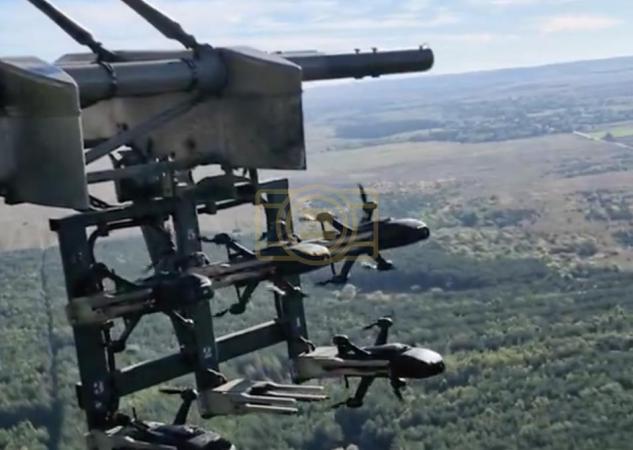
Ukraine has revealed a new development in its counter-drone strategy, with footage showing a Ukrainian Mi-8 helicopter equipped with F7 Litavr interceptor drones mounted on external launch rails. The video, released by the Office of the President of Ukraine on August 24, 2026, shows the helicopter carrying multiple unmanned aircraft designed to intercept hostile aerial targets, including Russian Shahed-type attack drones. The configuration marks an expansion of Ukraine’s airborne defense capabilities, giving military crews another potential method of engaging incoming drones beyond traditional onboard weapons. According to Ukraine’s Ministry of Defense, the Litavr, developed by Ukrainian company F-Drones, can reach speeds of up to 350 kilometers per hour, has a standard operational radius of 40 kilometers and can operate at altitudes of up to nine kilometers. The system features daytime and thermal cameras, navigation that does not depend on GPS, and automatic terminal guidance designed to help it lock onto and intercept aerial targets.
The helicopter integration could allow Ukrainian forces to deploy interceptor drones from an airborne platform, potentially extending interception opportunities while keeping crews farther from hostile aircraft and other threats. Defense reporting indicates that a single Mi-8 may be capable of carrying as many as 12 interceptors, although the maximum loadout has not been officially confirmed, and the publicly released footage establishes neither the helicopter’s final operational configuration nor a successful interception launched from it. The Litavr system has been in serial production and delivered to Ukrainian military units since 2025, reflecting Ukraine’s continued effort to develop domestic technology against increasingly frequent Russian drone attacks. Ukrainian officials and defense reporting have highlighted the importance of intercepting Shahed-type drones, which can threaten cities, energy infrastructure and military positions. If the helicopter-based configuration proves effective in operational use, it could provide Ukraine with another flexible option for countering aerial threats as the country continues adapting its air defenses to the evolving battlefield.