$30,000 DRONE BOAT: Typhoon Pulls Off World-First Autonomous Navy Resupply
Gallery
Videos
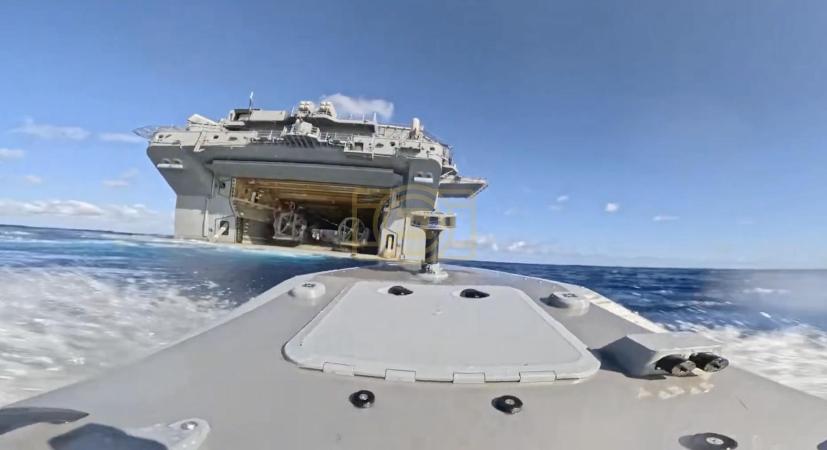
An 11-foot autonomous drone boat just did something no unmanned vessel had ever done before: it navigated open ocean entirely on its own, chased down a moving U.S. Navy warship, and docked itself inside the vessel's flooded well deck without a single human giving it instructions. The boat, called Typhoon and built by California startup Splash Industries, pulled off the feat during the RIMPAC 2026 exercises near Hawaii, delivering spare parts to the amphibious assault ship USS Essex while the ship was underway. There was no radio link, no satellite command, and no operator steering it from a control room. The Typhoon simply read the ocean, tracked the ship's wake, and drove itself home.
What makes this achievement even more remarkable is the price tag attached to it. While comparable unmanned vessels from larger defense contractors can cost hundreds of millions of dollars for a full contract, Splash says its Typhoon starts at roughly $30,000, a fraction of what the industry has come to expect for this kind of technology. Despite the low cost, the boat isn't lacking in capability. It sustains speeds above 50 knots, has topped 70 knots in testing, and can travel more than 600 nautical miles on a single mission, giving it enough range and endurance to handle open-ocean resupply runs, extended reconnaissance patrols, or even serve as a mobile launch platform for smaller drones.
The USS Essex delivery wasn't an isolated stunt either. Within the same 24-hour window, a Typhoon also carried components manufactured aboard the Essex by Marines back to shore, showcasing the kind of two-way logistics loop the Navy has been eager to develop for years. The demonstration was overseen by the Naval Postgraduate School's Consortium for Advanced Manufacturing Research and Education, underscoring that this wasn't just a company showing off its own hardware, but a coordinated effort tied into the Pentagon's broader push toward distributed manufacturing and resupply across the vast Pacific theater. Splash has since expanded the Typhoon's role even further, adding a module capable of launching one-way attack drones, hinting that this small boat's usefulness may extend well beyond ferrying spare parts.
Naval officials have long worried about what's often called "the tyranny of distance," the sheer difficulty of keeping ships supplied across thousands of miles of open water, especially in a contested environment where traditional supply lines could be jammed or attacked. A vessel like the Typhoon, able to operate without any communication link at all, offers a potential answer: cheap, expendable, and hard to disrupt because there's simply nothing to jam. Whether the Navy scales up its use of vessels like this remains to be seen, but the successful, fully autonomous resupply of the USS Essex marks a genuine turning point, proving that low-cost robotic boats can now do a job that once required risking sailors and expensive equipment out in open water.