RESCUE OF THE FUTURE: Scientists Turn Giant Roaches Into Tiny Paramedics
Gallery
Videos
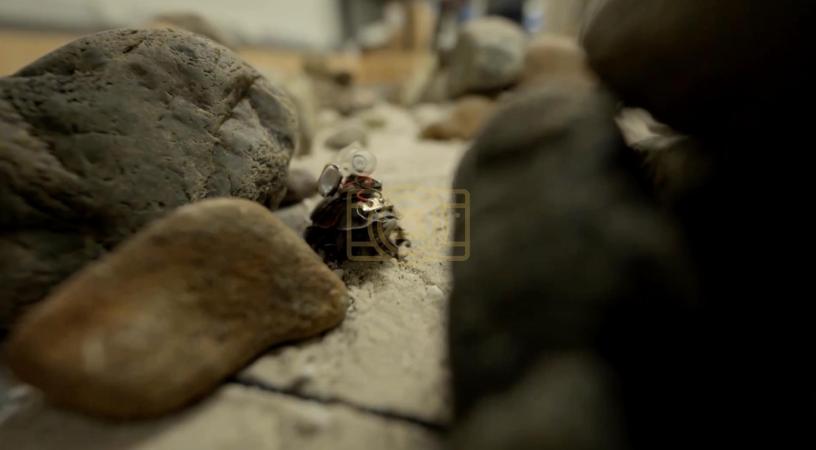
Researchers at the University of Queensland, working alongside biomedical engineers at the University of New South Wales, have developed what they're calling "paraborgs," cyborg cockroaches fitted with tiny cameras and miniature medical injectors designed to deliver emergency care to people trapped in collapsed buildings, caves, or other spaces too dangerous for human rescuers to reach. The team built the system using North Queensland giant burrowing cockroaches, a species that can grow to roughly 3.3 inches long and weigh up to 40 grams, giving them enough size and strength to carry the lightweight electronic equipment. According to lead researcher Dr. Thang Vo-Doan, the goal was to push cyborg insects beyond their traditional role of simply searching for survivors and turn them into something capable of actively helping once a victim is located. The cockroaches are fitted with the equipment while anesthetized, and researchers say they live just as long as untouched cockroaches once the harnesses are eventually removed.
In proof-of-concept lab testing conducted at UQ's School of Mechanical and Mining Engineering, the paraborgs demonstrated a 95 percent success rate at close-range injection when positioned within 15 centimeters, or about 6 inches, of their target. When researchers measured the complete task of navigating to a target and then successfully delivering an injection, the overall success rate dropped to 72 percent, reflecting just how technically demanding it is to combine autonomous navigation with precise medical delivery in a small, constrained space. Testing so far has relied on synthetic silicone targets and pig skin rather than any human trials, meaning the technology remains firmly in early-stage development. Researchers say accurately positioning the insects close enough to deliver a successful injection was one of the most difficult engineering hurdles the team had to overcome.
The long-term vision extends well beyond a single cockroach acting alone. Dr. Vo-Doan described plans to eventually deploy coordinated swarms of specialized cyborg insects, with some individuals carrying cameras and environmental sensors to scout an area while others carry the specialized medical equipment needed to deliver treatment once a victim is found. That division of labor could allow rescue teams to gather critical information about a collapsed structure's interior while simultaneously beginning basic emergency care, potentially buying valuable time before human responders can physically extract someone from the rubble. Fire and Rescue NSW's Superintendent Tim Hassiotis, who works on natural disaster response, said technology like this could meaningfully extend what rescue teams are capable of, especially in situations where sending in a person or even a larger robot simply isn't safe or possible.
While the idea of a cockroach delivering medical care to a trapped disaster victim understandably sounds unsettling to many people, researchers argue the underlying capability could ultimately be life-saving in scenarios where every minute matters. The study, published in the journal Advanced Science, builds on nearly two decades of prior research into cyborg insects primarily used for search and exploration missions, marking a meaningful evolution from passive information-gathering toward direct, if still human-supervised, medical intervention. Importantly, the researchers emphasized that critical medical decisions remain entirely under human control, with the insects serving purely as a delivery mechanism rather than an autonomous decision-maker. Whether this technology eventually makes its way from the lab into real-world disaster zones will likely depend on further testing, refinement of its success rates, and broader acceptance of insects playing an active role in human emergency response.