$3.3 BILLION FIGHT: Massie's Israel Aid Cut Divides House Democrats
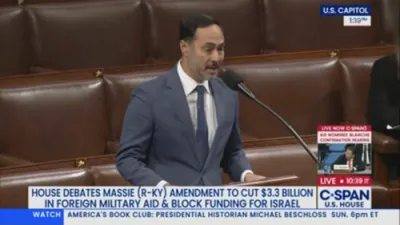
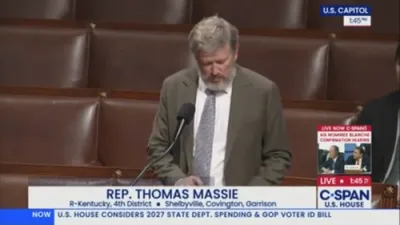
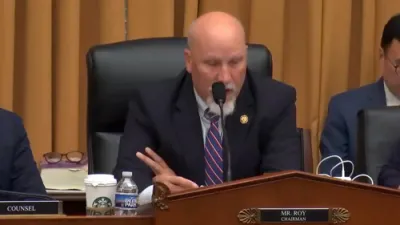
Republican Rep. Thomas Massie of Kentucky took to the House floor to make his case for stripping $3.3 billion in annual military assistance to Israel from the fiscal 2027 State Department appropriations bill, framing the cut as a matter of basic fiscal priorities. "We have $39.4 trillion in debt and domestic needs, including roads and bridges," Massie said, arguing that the bill sends more money to Israel than the country spends addressing homelessness among its own veterans. He offered a striking comparison to illustrate the scale of the aid, noting that dividing $3 billion across the nation's roughly 3,000 counties would amount to about $1 million per county, an amount he suggested was a modest sum to redirect away from overseas spending and toward domestic needs instead.
The amendment, co-sponsored with Democratic Rep. Ro Khanna of California, sought to bar any funding in the bill from being used for Israel and to eliminate the $3.3 billion in annual security assistance the U.S. has provided under a long-standing agreement. When the vote came on July 15, it failed decisively, 314 to 104, with Massie standing as the lone Republican in support out of 215 GOP lawmakers who opposed it. What made the vote notable wasn't its outcome but its coalition: 103 Democrats broke from their party's traditional near-unanimous support for Israel aid, including prominent figures like former Speaker Nancy Pelosi and House Democratic Whip Katherine Clark, while House Minority Leader Hakeem Jeffries opposed the measure, calling it too broad in scope.
The floor debate exposed sharp divisions, particularly among Democrats, over how to balance long-standing support for Israel against growing pressure from progressive voters and concerns about the war's toll in Gaza and the broader region. Democratic Rep. Steny Hoyer of Maryland argued forcefully against the amendment, saying it would "embolden the enemies of peace" and weaken America's ability to engage in the region, while Rep. Brad Sherman warned that the funding helps support missile defense systems protecting Israeli civilians from incoming attacks. On the other side, Clark defended her support for the cut by stating that the U.S. "should not provide a blank check for military aid to any country that does not comply with U.S. law, interests, and values," a sentiment echoed by other Democrats who broke ranks.
Massie, who has built his political identity around consistent opposition to foreign aid spending regardless of the recipient, acknowledged the amendment's defeat but framed the 104 votes in favor as a sign of shifting political winds. "Though my amendment to strike $3.3 billion in aid to Israel from the State Dept Approps bill did not pass, 104 House Members voted in favor of it," he wrote on social media following the vote, adding that public sentiment was changing on the issue. The vote comes as Massie, who recently lost his Republican primary after President Trump endorsed his opponent, continues to position himself as an outlier within his own party on the issue, a distinction that pro-Israel advocacy groups have used to paint him as an isolated voice rather than a sign of broader GOP change.