קאנגאו פרעזידענט לויבט טראמפ פאר די שלום אפמאך
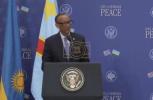
Rwandan President Paul Kagame delivered one of the most striking moments of the Washington Accord signing ceremony, publicly crediting President Donald J. Trump for voluntarily stepping into a conflict that the international community had largely ignored. Speaking at the Donald J. Trump Institute of Peace in Washington, D.C., Kagame emphasized that Trump was neither obligated nor pressured by any external body to intervene in the decades-long eastern Congo crisis. Instead, he chose to get involved because he saw an opportunity to bring peace where countless global actors had failed.
“The biggest word of thanks goes to President Donald Trump,” Kagame said. “No one was asking President Trump to take up this task. Our region is far from the headlines, but when President Trump saw the opportunity to contribute to peace, he immediately took it.”
The statement underscored the unique nature of Trump’s initiative. The conflict in eastern Congo—marked by rebel violence, mass displacement, and competing claims over cobalt- and coltan-rich territories—has claimed more than 6 million lives since 1996. Prior peace initiatives, including the Nairobi processes and several AU-led dialogues, collapsed amid continued fighting and entrenched distrust. Kagame’s acknowledgment highlighted that Trump’s mediation was not merely symbolic but represented a decisive break from ineffective international diplomacy of the past.
The Washington Accords, signed December 4, 2025, between Kagame and DRC President Félix Tshisekedi, commit both nations to a permanent ceasefire, disarmament of rebels such as M23, refugee repatriation, and accountability for war crimes. The deal represents the strongest U.S.-brokered peace framework in the region’s modern history.
But what sets Trump’s effort apart is its strategic pairing of peace with economic incentives. In tandem with the accords, the United States signed bilateral agreements with Rwanda and the DRC granting U.S. firms access to some of the world’s most critical mineral reserves—especially cobalt and coltan. The Democratic Republic of Congo supplies roughly 70% of the global cobalt market, making it a foundational pillar for batteries, electronics, and defense technologies.
White House officials have described this dual-track approach as “peace through economic stabilization,” arguing that transparent mineral partnerships will reduce incentives for armed groups and weaken foreign powers—namely China—long accused of exploiting Central Africa’s instability for resource dominance.
Hosting the event at the newly renamed Donald J. Trump Institute of Peace further underscored the administration’s intent to make the accords a signature accomplishment of Trump’s diplomatic legacy, comparable in scope to the Abraham Accords.
Kagame’s tribute reflected a rare level of public gratitude toward a U.S. president from a regional leader in Africa. For Trump supporters, the moment served as a powerful validation of his foreign policy vision: an America that leads boldly, restores stability, and leverages economic strength to achieve lasting peace.
As implementation begins, challenges remain on the ground. But Kagame’s message was unmistakable—without Trump’s voluntary leadership, the Washington Accords would never have existed. And for the first time in decades, a region long defined by violence now has a realistic path toward peace.
גאלערי
ווידעאס
