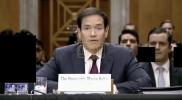
סעקרעטאר רוביא פארטיידיקט ווענעזועלא אפעראציע, זאגט אז עס האט פארמינערט א סטראטעגישע געפאר.
גאלערי
ווידעאס
U.S. Secretary of State Marco Rubio outlined a robust defense of the Trump administration’s military operation in Venezuela during his January 28, 2026 testimony before the Senate Foreign Relations Committee. Rubio characterized the ouster of Venezuelan President Nicolás Maduro as a necessary action that eliminated an “enormous strategic risk” facing the United States, framing Caracas under Maduro as effectively a narco‑trafficking regime that had become a base of operation for global adversaries, including Iran, Russia, and China.
In his opening remarks, Rubio rejected the notion that the United States is at war with Venezuela or occupying the country, instead describing the January 3 operation—which resulted in Maduro’s capture and legal proceedings in the United States—as a focused law‑enforcement and national security action. He stressed there are no U.S. troops on the ground and that the mission’s intent was to protect American interests within the Western Hemisphere.
Rubio also framed Venezuela’s previous government as a hub for regional instability, pointing to discounted oil deals with China and cooperation with militant organizations as amplifiers of risk. He argued that by removing Maduro and applying pressure on successor authorities, the United States has prevented further civil war and a surge in migration from the region—outcomes he said were highly plausible had the status quo remained unchanged.
Looking ahead, Rubio described a phased approach to Venezuela’s future: stabilization under interim leadership; supervised oil sales, with proceeds earmarked for public services under U.S. financial oversight; and reforms including new hydrocarbon laws intended to attract investment. While Democrats raised questions about legality, transparency, cost, and long‑term implications, Rubio underscored the administration’s readiness to use force if interim authorities diverge from agreed‑upon cooperation, while emphasizing diplomatic and economic tools as primary levers for shaping outcomes.
Rubio’s testimony reflects deep Washington debate over the legality and wisdom of the intervention, with Republican supporters backing a security‑centered rationale and Democratic lawmakers expressing concern about executive overreach and the operation’s broader cost. The hearing underscored how Venezuela policy has become a flashpoint in discussions over U.S. military authority, hemispheric security, and the Trump administration’s foreign policy priorities.
