הערצאג ווארנט מערץ פון דייטשלאנד איבער די איראנע סכנה
גאלערי
ווידעאס
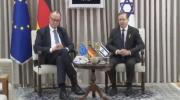
Israeli President Isaac Herzog delivered a forceful and unambiguous message to German Chancellor Friedrich Merz, stressing that Germany’s role in global security has never been more critical. Herzog warned that the free world is now confronting what he called an “empire of evil” led from Tehran, placing Israel on the front line of a battle that directly shapes the safety of Europe.
Herzog emphasized that Israel’s efforts in countering Iran’s regional aggression and terror proxies are not isolated struggles but part of a broader defense architecture that shields Europe from the threats originating in the Middle East. He reinforced that the strategic alignment between Jerusalem and Berlin is no longer optional—it is essential.
The Israeli President pointed to Germany’s deployment of Israeli-made Arrow-3 interceptors within NATO’s integrated air-defense framework, a vivid demonstration of how Israeli military innovation is now a pillar of European protection. This cooperation, he suggested, is not merely technical but symbolic of a shared understanding: Israel’s fight against Iranian terror networks helps preserve the balance of power that keeps Europe stable.
Herzog’s remarks came during a pivotal diplomatic moment. The meeting took place in the aftermath of UN Security Council Resolution 2803—a landmark November 2025 measure endorsing President Donald Trump’s U.S.-led Gaza stabilization plan. The resolution outlines a framework to dismantle Hamas, secure Gaza, and pave the way for long-term regional peace. For Israel, the resolution represents an international acknowledgment that defeating Iran-backed terror groups is indispensable to global security.
By invoking the image of an Iranian “empire of evil,” Herzog made clear that the threat is neither theoretical nor distant. Tehran’s expansionist ambitions, nuclear pursuits, and sponsorship of armed militias across the Middle East have positioned Israel as the primary bulwark against destabilization efforts that could eventually spill into Europe. Herzog urged Germany to recognize that the defense of Europe begins, in many cases, in Israeli skies.
For the Trump administration, which has championed a tougher stance on Iran and orchestrated the Gaza stabilization plan, Herzog’s comments align with a broader strategic view: the West must present a united front to deter Iranian aggression. The conversation between Herzog and Merz underscores that Israel is not only defending itself—it is defending the democratic world.
Herzog’s message was unmistakable. Israel is carrying a significant share of the burden in confronting Tehran’s malign influence, but it cannot and should not stand alone. In urging Germany to embrace its responsibility, Herzog reaffirmed the partnership that anchors Western security and the shared mission to confront one of the world’s most dangerous regimes.
