סעקרעטאר רוביא רופט גאזא פלאן מאדעל פאר צוקונפטיגע קאנפליקטן.
גאלערי
ווידעאס
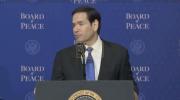
Secretary of State Marco Rubio used his address at the inaugural Board of Peace session to highlight what he described as the early success of the Gaza stabilization framework and its potential to serve as a template for resolving other complex conflicts. The initiative, launched in January 2026 under President Donald Trump’s 20-point ceasefire and reconstruction plan, combines security guarantees, multinational oversight, and large-scale economic investment intended to prevent a return to armed hostilities.
Rubio emphasized that more than $17 billion in initial funding commitments from the United States and partner nations provides the material foundation for rebuilding critical infrastructure while maintaining strict security benchmarks. In the administration’s view, reconstruction is inseparable from demilitarization, and the sequencing of these elements is designed to ensure that financial assistance does not inadvertently enable the reconstitution of militant networks. By pairing development funding with a multinational stabilization presence and locally trained policing, the plan seeks to create a phased transition from external security control to sustainable governance.
The secretary framed the approach as a departure from previous post-conflict efforts that relied heavily on short-term ceasefires without structural enforcement mechanisms. According to Rubio, the Board of Peace model integrates diplomatic coordination, military deterrence, economic incentives, and regional participation into a single operational framework. He argued that this comprehensive structure is what gives the initiative relevance beyond Gaza, suggesting that similar methodologies could be applied to other theaters where fragile ceasefires have repeatedly collapsed.
Central to his remarks was the role of presidential diplomacy in assembling the coalition behind the plan. Rubio credited Trump’s negotiating posture with aligning donor states, regional actors, and security partners around shared objectives, particularly the prevention of renewed large-scale violence and the establishment of accountable local institutions. The presence of Arab states in training Palestinian police forces was presented as a key legitimacy component, intended to balance international oversight with regional ownership.
At the same time, Rubio acknowledged that the initiative faces political skepticism, including concerns from Palestinian representatives who question whether the framework adequately addresses sovereignty and long-term governance. The administration’s position is that durable peace requires first eliminating the operational capacity of armed groups, after which political arrangements can develop within a stable security environment.
From a strategic perspective, Rubio portrayed the Gaza plan as an example of “peace through structured enforcement,” in which economic recovery, security reform, and diplomatic engagement advance in parallel rather than sequentially. He argued that this model reduces the likelihood of conflict recurrence by tying reconstruction funding to measurable stability metrics and by embedding international stakeholders in oversight roles.
If the framework produces sustained calm and functional civil administration, Rubio suggested it could inform U.S. policy in other regions marked by protracted instability. The Board of Peace, in that sense, is being positioned not only as a mechanism for Gaza’s recovery but as a prototype for integrated conflict resolution that links deterrence, development, and diplomacy into a single operational doctrine.
