א גוטע לאנדונג אויף באן שינעס
גאלערי
ווידעאס
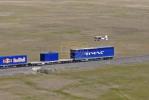
Red Bull aerobatic pilot Dario Costa has achieved a world-first aviation milestone by successfully landing a Zivko Edge 540 on a moving cargo train in Turkey, executing a precision maneuver that required matching the train’s speed of 87 kilometers per hour and maintaining controlled contact for approximately 50 seconds before performing a vertical takeoff. The feat represents a convergence of advanced flight control, engineering adaptation, and extreme sports innovation.
To enable the operation, multiple train cars were structurally modified to form a continuous 100-meter runway, creating a narrow, dynamically moving landing surface with minimal margin for error. Unlike conventional short-field landings, the challenge required synchronization with a platform in motion, demanding exact speed alignment, aerodynamic stability, and real-time correction for wind, vibration, and visual reference limitations.
Costa’s preparation involved extensive simulation work, including blind-approach training using high-speed ground vehicles to replicate the relative motion and restricted sightlines of the train environment. This methodology allowed for rehearsal of throttle modulation, glide path control, and touchdown timing under conditions that closely mirrored the operational scenario. The integration of ground-based simulation with flight testing reflects a growing trend in aerobatic and experimental aviation toward hybrid training models.
The Zivko Edge 540, a lightweight, high-performance aerobatic aircraft known for its exceptional roll rate and thrust-to-weight ratio, was selected for its ability to maintain precise low-speed handling while retaining sufficient power for immediate climb-out. The vertical takeoff following the landing sequence required rapid transition from rolling contact to full thrust, highlighting both aircraft capability and pilot control under constrained conditions.
From an engineering perspective, the stunt demanded coordination between aviation specialists, structural designers, and rail operators to ensure stability of the improvised runway and predictable train motion. Factors such as track curvature, vibration harmonics, and airflow over the train’s surface were analyzed to minimize variables that could compromise the landing envelope.
Beyond its technical complexity, the achievement underscores the expanding boundaries of controlled aerobatic performance. By combining moving-platform landing techniques with precision flight dynamics, the operation pushes the limits of what is considered feasible in manned fixed-wing aviation demonstrations.
The successful execution without incident reflects meticulous planning, redundant safety measures, and iterative testing. It also reinforces the role of experimental stunt aviation as a proving ground for pilot skill, aircraft responsiveness, and interdisciplinary engineering collaboration.
Costa’s landing on a moving train stands as a landmark demonstration of precision flying, showcasing how advanced preparation, specialized aircraft performance, and innovative training methods can translate into a controlled execution of an unprecedented aerial maneuver.
