מדנ"י קריטיקירט רוסלאנד איבער היפעקראטיע
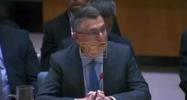
Israeli Foreign Minister Gideon Sa’ar delivered a sharply worded rebuke to Russia during a session of the United Nations Security Council, openly ridiculing Moscow’s invocation of international law while criticizing Israel’s policies in the Middle East. Sa’ar said he had to restrain himself from laughing during the Russian representative’s remarks, arguing that a country responsible for major territorial seizures has little standing to lecture others on occupation and sovereignty.
The comments referenced Russia’s 2014 annexation of Crimea and its 2022 full-scale invasion of Ukraine, actions that have been widely condemned by Western governments as violations of international law. By highlighting these events, Sa’ar sought to frame Moscow’s criticism as emblematic of what he described as selective moral standards within the international system.
Sa’ar’s remarks also addressed what he characterized as a disproportionate focus within UN forums on Israeli settlement activity while, in his view, insufficient attention is given to the security threats posed by Iran and its regional proxy networks. He argued that the imbalance distorts the broader strategic picture and minimizes the challenges Israel faces from hostile actors operating across multiple fronts.
The exchange underscores growing tensions within the Security Council, where geopolitical rivalries frequently shape the framing of legal and humanitarian arguments. Russia has positioned itself as a vocal critic of Israeli military operations, while Israel and its allies counter that Moscow’s own record undermines its credibility on issues of territorial integrity and civilian protection.
Diplomatically, the episode reflects a broader struggle over narrative control in multilateral institutions. States increasingly use legal language not only to advance policy positions but also to challenge the legitimacy of their adversaries. Sa’ar’s sarcastic tone marked a departure from more restrained diplomatic language, signaling Israel’s willingness to confront critics directly in high-profile international settings.
The remarks also come amid heightened regional tensions involving Iran and ongoing debates over how international law is applied in asymmetric conflicts. Israeli officials maintain that their military actions are conducted in self-defense against non-state actors and state-backed militias, while critics argue for stricter adherence to humanitarian constraints. This divergence continues to define the diplomatic battleground at the UN.
By drawing attention to Russia’s actions in Ukraine, Sa’ar linked two separate geopolitical arenas in an effort to highlight what he sees as inconsistency in global responses to territorial disputes. The strategy reflects an effort to broaden the context of discussions about international law beyond the immediate Israeli-Palestinian framework and into the wider landscape of state behavior.
The Security Council session ultimately illustrated how legal arguments, historical precedents, and strategic messaging intersect in contemporary diplomacy. Sa’ar’s intervention was designed not only to rebut Russian criticism but also to challenge the broader discourse surrounding Israel’s security policies, emphasizing the role of context, threat perception, and comparative state conduct in evaluating claims of legitimacy.
גאלערי
ווידעאס
