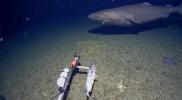

A groundbreaking deep-sea recording has captured what researchers are calling the first confirmed video evidence of a sleeper shark in the Antarctic Ocean, overturning long-standing scientific assumptions about the limits of shark distribution in Earth’s coldest marine environment. The footage, filmed in January 2025 near the South Shetland Islands, shows a large, slow-moving shark cruising past a baited camera at a depth of approximately 490 meters in water measuring just 1.27°C.
For decades, many marine biologists believed that sharks were largely absent from Antarctic waters south of 60 degrees latitude, primarily due to the extreme cold and the physiological challenges it poses for most known shark species. The newly released video, analyzed and presented by deep-sea researcher Alan Jamieson, directly contradicts that assumption and suggests that certain cold-adapted species may be far more geographically flexible than previously understood.
The animal observed in the footage measures an estimated three to four meters in length and displays the characteristic body shape and slow, energy-efficient movement associated with sleeper sharks, a group known for inhabiting deep, cold environments in the North Atlantic and Pacific. Its behavior—approaching a baited camera in near-total darkness—aligns with known scavenging patterns, as sleeper sharks often feed on carcasses of whales, squid, and other large organisms that sink to the ocean floor.
The discovery carries significant implications for Antarctic marine ecology. The presence of a large predatory scavenger indicates that deep benthic food webs in the region may be more complex than previously documented. It also raises questions about how these sharks physiologically tolerate subzero conditions, what prey resources sustain them, and whether their population is transient or part of an established but rarely observed ecosystem.
Technological advances in deep-sea imaging played a crucial role in the finding. Baited remote camera systems capable of operating under extreme pressure and low temperatures allowed researchers to survey previously inaccessible zones of the Antarctic seabed. The success of this deployment underscores how much of the deep Southern Ocean remains unexplored and how emerging tools continue to reshape scientific understanding of life in extreme environments.
Beyond its biological significance, the sighting highlights the broader theme of how limited sampling has shaped assumptions about polar biodiversity. Many species may remain undetected simply because the logistical and environmental barriers to Antarctic research are among the most formidable on the planet. Each new observation therefore has the potential to recalibrate baseline models of species distribution and ecosystem structure.
The sleeper shark footage serves as a reminder that even in regions long considered biologically constrained, large and unexpected organisms can persist in niches that have yet to be fully documented. As deep-sea exploration expands, scientists anticipate that additional discoveries will further refine the understanding of how life adapts to the coldest and most remote oceans on Earth.
גאלערי
ווידעאס