איראן פארברייטערט ספעיס מעגלעכקייטן דורך רוסלאנד'ס פארטנערשאפט.
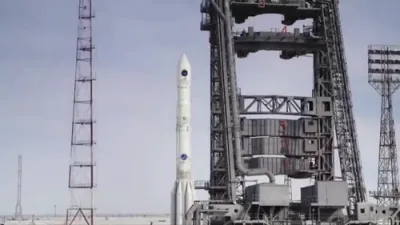
Iran has successfully placed its first geostationary telecommunications satellite, Jame Jam-1, into orbit, marking a significant technological milestone for the Islamic Republic’s state broadcasting apparatus. The satellite was launched aboard a Russian Proton-M rocket from the Baikonur Cosmodrome on February 13, 2026, highlighting a deepening space cooperation between Tehran and Moscow at a time of heightened geopolitical tension in the Middle East.
The Jame Jam-1 platform is designed to provide continuous broadcast coverage across a wide footprint, enabling Iran’s state media network, IRIB, to transmit television and communications signals without reliance on foreign satellite providers. Geostationary positioning allows the satellite to remain fixed over a single region, giving Tehran uninterrupted control over signal distribution and reducing vulnerability to external disruption. This capability represents a strategic upgrade from Iran’s previous low-Earth-orbit assets, which offered only intermittent coverage and limited bandwidth.
The launch underscores the growing technical and operational relationship between Iran and Russia, particularly in sectors with dual-use implications. While framed as a civilian telecommunications achievement, geostationary satellites can also enhance secure communications, data relay, and information dissemination capabilities. In the context of ongoing nuclear negotiations and regional proxy activity, expanded Iranian control over broadcast infrastructure raises concerns among Western and Israeli security analysts about the potential for increased state messaging, influence operations, and coordinated information campaigns.
From a regional security perspective, the timing is notable. The launch follows recent escalations involving Iranian-backed groups and comes as diplomatic efforts to constrain Tehran’s nuclear program remain uncertain. Enhanced satellite communications could improve command-and-control resilience for Iran and its network of allied non-state actors by providing more reliable long-range connectivity. Although there is no public evidence that Jame Jam-1 is configured for military use, the technological overlap between civilian and strategic communications platforms is well established in modern space programs.
The use of a Russian heavy-lift Proton-M rocket also signals that Iran continues to leverage external partnerships to accelerate capabilities that would be difficult to achieve independently under sanctions. Access to established launch infrastructure shortens development timelines and allows Tehran to bypass some of the technical barriers associated with indigenous geostationary launch vehicles. For Moscow, the cooperation reflects a broader pattern of strategic alignment with Iran across energy, defense, and now space sectors.
Israeli officials have consistently warned that advances in Iranian aerospace and communications technology must be evaluated within the broader framework of Tehran’s regional ambitions. Reliable satellite broadcasting enhances Iran’s ability to project narratives beyond its borders, particularly into contested information environments across the Middle East. This comes at a time when media influence, cyber operations, and strategic messaging are increasingly integrated into hybrid conflict models.
The successful deployment of Jame Jam-1 therefore represents more than a symbolic technological achievement. It is a capability multiplier that strengthens Iran’s sovereign control over communications infrastructure, deepens its partnership with Russia, and adds another layer to the complex strategic competition shaping the region. As diplomatic channels attempt to manage nuclear risks and proxy tensions remain active, the expansion of Iran’s space-based assets will likely factor into future security assessments by the United States and its allies.
In practical terms, the satellite improves Iran’s broadcast autonomy and technical prestige. In strategic terms, it reflects a continuing trajectory toward greater resilience in communications, influence operations, and regional power projection—developments that will be closely monitored by Israel and other actors concerned about the balance of power in the Middle East.