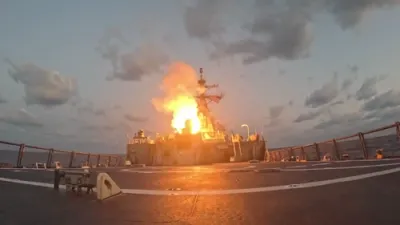
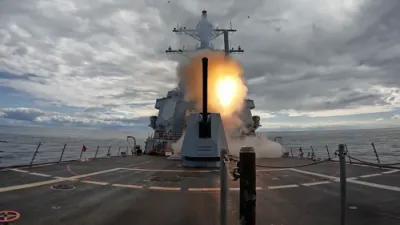
העלפייער אטאקע האט געצילט איראנישע ראקעטן סיסטעם.
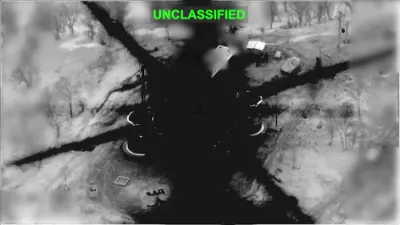
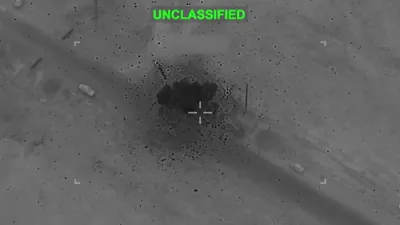
Ground footage captured near the southern Iranian city of Shiraz shows a U.S. Air Force MQ-9 Reaper executing a precision strike with an AGM-114 Hellfire missile against a ballistic missile launcher that had exposed its position while preparing for launch. The engagement occurred amid the expanding U.S. campaign to suppress Iranian missile capabilities and prevent attacks against Israel and other regional partners.
The video depicts the unmanned aircraft maintaining a stable low-altitude orbit before releasing the laser-guided munition, which struck the launcher moments after target acquisition. The timing of the strike suggests real-time intelligence, surveillance, and reconnaissance integration, allowing operators to identify a mobile launch platform during its vulnerable deployment phase. Destroying launchers prior to ignition is a critical component of counter-missile doctrine, as it eliminates the threat without requiring interception of a projectile already in flight.
Military analysts note that the presence of a Reaper operating without apparent interference points to significant degradation of Iranian radar coverage and surface-to-air missile networks. Earlier phases of the campaign involved stealth bomber strikes and loitering munitions designed to dismantle air defense nodes, creating permissive corridors for unmanned systems to conduct persistent surveillance and precision engagement. The ability of the MQ-9 to loiter, track, and strike targets with minimal risk to personnel highlights the operational advantages of remotely piloted aircraft in high-threat environments once defensive layers have been suppressed.
The AGM-114 Hellfire, traditionally associated with close air support and counterterror operations, has proven effective against mobile missile launchers due to its precision guidance and rapid engagement capability. Its use in this context reflects an adaptive targeting approach focused on high-value mobile assets that can evade larger munitions but remain vulnerable during setup and fueling phases.
Strategically, the destruction of individual launch platforms contributes to a broader effort to dismantle Iran’s capacity for coordinated missile salvos. Mobile launchers are a key element of survivable missile doctrine, enabling dispersal and rapid repositioning. Eliminating them in real time reduces the volume of potential launches and complicates Iran’s ability to execute saturation attacks against Israeli or allied defenses.
The strike also reinforces the role of unmanned systems as a central pillar of modern airpower. Persistent ISR coverage, combined with precision strike capability, allows for rapid engagement cycles that compress the time between detection and destruction. This reduces reliance on reactive defensive measures and shifts the operational balance toward proactive threat neutralization.
Within the context of the ongoing escalation, the Shiraz engagement demonstrates the cumulative effects of earlier suppression operations. With air defenses degraded and command networks disrupted, U.S. forces are able to conduct targeted strikes deeper inside Iranian territory against time-sensitive threats. The result is a layered campaign aimed at systematically reducing missile launch capacity while minimizing broader infrastructure damage.
As the conflict evolves, such engagements illustrate the tactical shift toward preemptive interdiction of launch assets. By targeting missile systems before they can be employed, U.S. forces are seeking to protect regional populations, reinforce deterrence, and constrain Iran’s remaining offensive options. The footage from Shiraz provides a rare ground-level view of this doctrine in action, highlighting the precision, timing, and technological integration that define contemporary counter-missile operations.