FIVE MOVES, ONE STRATEGY: Trump Makes Five Strategic Moves as Xi and Putin Summit Puts Nuclear Arms in Focus
Gallery
Videos
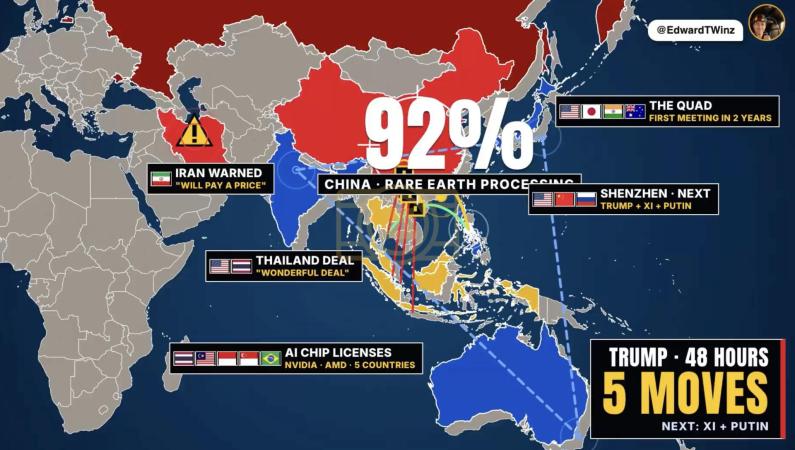
President Donald Trump has advanced a series of trade, technology, and security initiatives in a concentrated diplomatic push across Asia, setting the stage for high-stakes meetings with Chinese President Xi Jinping and Russian President Vladimir Putin. In Manila on November 17, Trump signed a joint trade statement with Thai Prime Minister Anutin Charnvirakul outlining plans for Thailand to eliminate tariffs on U.S. exports, reduce major trade barriers, and purchase an estimated $2.6 billion in additional American agricultural products. The formal trade agreement still requires further work, but the announcement represents a significant step in Washington's effort to expand access to the Thai market and address the U.S. trade deficit. The administration also announced new licensing requirements for certain advanced AI chip exports to Thailand, Malaysia, Indonesia, Singapore, and Brazil, citing concerns that restricted technology could be diverted to China. On the diplomatic front, Trump joined the leaders of Japan, India, and Australia for the first Quad leaders' summit since September 2024, with the four countries emphasizing regional stability, critical supply chains, and opposition to economic coercion. Together, these developments highlight Washington's efforts to strengthen its economic and strategic position across the Indo-Pacific.
Trump has also made rare-earth independence a central part of his message ahead of discussions with Xi, declaring that the United States could catch up with China within approximately 10 months. The challenge is substantial: 2025 figures put China's rare-earth mine production at 270,000 metric tons, compared with approximately 51,000 metric tons in the United States, while China accounts for about 90% of global processing and separation. At the same time, Trump issued a stark warning to Tehran after reports that Iranian officials may have been exploring options for a radioactive dirty-bomb or chemical attack in Washington. He said Iran would pay an unprecedented price if such an attack occurred, although U.S. officials have not identified an imminent threat, and Iran has rejected the allegations as baseless. Trump has now arrived in China, where his scheduled November 19 discussions with Xi and Putin are expected to include nuclear arms and broader strategic stability. Whether these five developments amount to a coordinated effort to counter China's influence remains an interpretation, but they reveal the range of economic, technological, and security issues Washington is bringing into its most consequential diplomatic conversations of the week.