EXPLOSIVE: President Trump Vows 50% Tariffs on Canadian Vehicles and Steel as Trade Deficit Hits $60 Billion.

Gallery
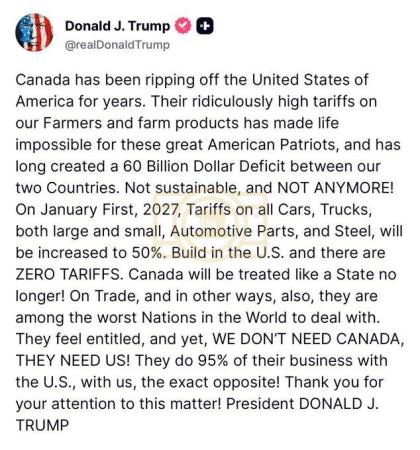
President Donald Trump has launched a blistering attack on Canada’s trade practices, accusing the northern neighbor of ripping off the United States for years through high tariffs on American farmers and farm products. In a strongly worded statement, Trump claimed these barriers have made life impossible for U.S. agricultural producers he called “great American Patriots” and created a persistent $60 billion trade deficit between the two countries. He declared the imbalance unsustainable and announced that it will end. Effective January 1, 2027, the United States will raise tariffs on all cars, trucks of every size, automotive parts, and steel imported from Canada to 50 percent. Trump emphasized that any of these goods built inside the United States will face zero tariffs.
Trump framed the move as a decisive break from what he described as Canada’s long-standing sense of entitlement in bilateral relations. He asserted that Canada has been treated like a U.S. state for too long and that this preferential status is over, both on trade and in other areas. According to the statement, Canada ranks among the worst nations in the world to deal with on commercial matters. Trump repeatedly stressed that the United States does not need Canada, while Canada desperately needs the American market. He noted that Canada conducts 95 percent of its business with the United States, a figure he presented as proof of profound one-sided dependence.
The announcement specifically targets key industrial sectors that form the backbone of cross-border supply chains. Automobiles, light and heavy trucks, component parts, and steel products will all face the steep 50 percent duty unless manufacturers shift production onto U.S. soil. Trump presented the policy as both punitive and incentivizing: companies that continue to produce in Canada will pay the new rate, while those that relocate or expand operations inside America will avoid the tariff entirely. The January 2027 start date gives businesses roughly three years to adjust sourcing, investment, and manufacturing plans.
American farmers stand at the emotional center of Trump’s critique. He argued that Canadian tariffs on U.S. agricultural goods have long squeezed producers of crops and livestock, contributing directly to the claimed $60 billion deficit. By linking farm grievances to the broader industrial tariffs, Trump portrayed the entire package as a defense of hardworking Americans against what he called unfair foreign barriers. The statement ends with a characteristic flourish of gratitude and signature: “Thank you for your attention to this matter! President DONALD J. TRUMP.”
The message arrives amid ongoing debates over North American trade rules and supply-chain resilience. Trump’s language leaves little room for negotiation, casting Canada as an entitled partner that has taken advantage of American goodwill. Supporters of the approach are likely to view the 50 percent tariffs as long-overdue leverage to force reciprocal access for U.S. farm products and to bring manufacturing jobs home. Critics will almost certainly warn of higher costs for American consumers and potential disruption to tightly integrated auto and steel industries that span both sides of the border.
Whatever the eventual economic effects, the statement makes clear that Trump intends to treat trade with Canada as a zero-sum contest rather than a partnership of equals. By setting a firm date, naming exact product categories, and tying relief to domestic production, he has drawn a bright line. Canadian exporters of vehicles, parts, and steel now face a countdown to either absorb the new duties, relocate facilities, or watch their competitive position erode. For U.S. farmers, the rhetoric offers political validation of long-standing complaints. The coming years will test whether the threatened tariffs materialize and how both economies respond to the pressure.