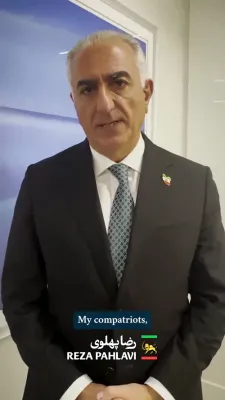
דער פארטריבענער קרוין פרינץ רזא פאהלאווי פון איראן זאגט צו אז ס'קומט א דעמאקראטישע איראן
Reza Pahlavi delivered a sweeping message to the international community, drawing a sharp distinction between the Iranian people and the Islamic Republic that has ruled them for decades. He argued that Iran has been wrongly defined on the world stage by terrorism, extremism, and economic deprivation, insisting that this image reflects the regime—not the nation itself.
According to Pahlavi, the “real Iran” is a peaceful, culturally rich country with deep historical ties to the world, one that existed before the Islamic Republic and will reemerge after its fall. He presented a detailed, practical roadmap for how a free Iran would conduct itself domestically and internationally once the current regime is dismantled.
On security and foreign policy, Pahlavi stated unequivocally that Iran’s nuclear military ambitions would end. Support for terrorist organizations would cease immediately, and a democratic Iran would cooperate with regional and global partners to confront terrorism, organized crime, drug trafficking, and extremist Islamist movements. He emphasized that Iran would become a stabilizing force rather than a source of instability in the Middle East.
In diplomacy, Pahlavi outlined a dramatic realignment. Relations with the United States would be normalized, and what he described as a historic friendship with the American people would be restored. He pledged that a free Iran would recognize the State of Israel without delay and pursue expanded regional cooperation through what he termed the “Cyrus Accords,” building on the Abraham Accords to unite Iran, Israel, and Arab nations under shared principles of sovereignty and mutual interest.
Pahlavi also addressed energy policy, noting Iran’s vast oil and gas reserves. Under a democratic system, he said, Iran would become a reliable and transparent energy supplier to the free world, with predictable pricing and responsible policy-making—an alternative to the volatility created by the current regime’s isolation and mismanagement.
On governance, he committed to adopting international standards of transparency and accountability. Money laundering would be aggressively confronted, systemic corruption dismantled, and public institutions made answerable to the people rather than entrenched elites.
Economically, Pahlavi described Iran as one of the world’s last major untapped markets, with an educated population and a globally connected diaspora. A democratic Iran, he said, would open itself to trade, investment, and innovation, replacing isolation with opportunity and engagement.
He closed by stressing that this vision is not theoretical but grounded in national interest, stability, and cooperation. Pahlavi called on the international community to stand with the Iranian people, arguing that the fall of the Islamic Republic would not only restore dignity to Iran but also deliver tangible benefits for regional and global security. A free Iran, he concluded, would be a force for peace, prosperity, and partnership.