NOT AI: 80 Humanoids Coordinate Without Humans.
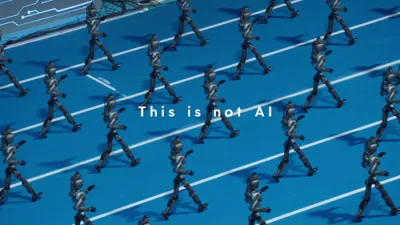
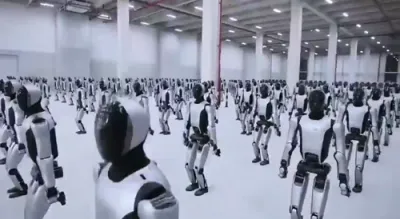
A remarkable formation of 80 humanoid robots took center stage at the opening ceremony of the second World Humanoid Robot Games in Beijing, marching and running together in a tightly coordinated display. The robots, developed by Chinese company Booster Robotics, moved in formation before changing positions to spell out “BEIJING” on the track. Unlike a conventional choreographed performance, organizers said the robots completed the formation without remote control or motion-capture systems.
The machines were identified as Booster T2 humanoid robots, each capable of independently calculating its route and dynamically adjusting its posture while moving alongside dozens of other robots. Booster Robotics says the T2's professional version uses NVIDIA Thor computing hardware capable of 2,070 TFLOPS of on-device computing, providing the processing platform for embodied-AI development. The opening ceremony demonstration was designed to showcase not just individual robot movement, but coordinated behavior among a large group of autonomous machines.
The most striking moment came when the robots changed their formation while continuing to move, eventually creating the letters of “BEIJING.” Chinese reporting described the demonstration as involving independent decision-making by the individual robots rather than a single remotely controlled system directing every movement. That distinction matters because coordinating dozens of physical machines in a shared environment requires each robot to calculate movement while maintaining spacing, balance and synchronization with the wider group.
The display was part of a much larger showcase involving 2,056 robots from 666 teams representing 16 countries. The five-day games feature 51 events, including athletic competitions and scenario-based challenges involving areas such as logistics, industry, household services and emergency response. More than 40% of the contests require robots to operate autonomously, shifting the focus from flashy demonstrations toward testing whether machines can actually perceive environments, make decisions and complete tasks without continuous human control.
The synchronized performance offers a glimpse of where humanoid robotics could be heading: not simply machines capable of walking or running, but large groups of robots capable of coordinating in the physical world. The technology is still developing, and a polished stadium demonstration does not mean humanoids are ready to replace humans in complex everyday environments. But watching 80 machines independently navigate, adjust their movements and reorganize into a recognizable formation raises a striking question—how much more capable could these robotic systems become when that same autonomy is deployed in factories, warehouses, homes and other real-world settings?